
Nikol Baveyan: The Gramophone Co and Documentation of Ashugh Repertoire
Written by Jesse Kenas Collins
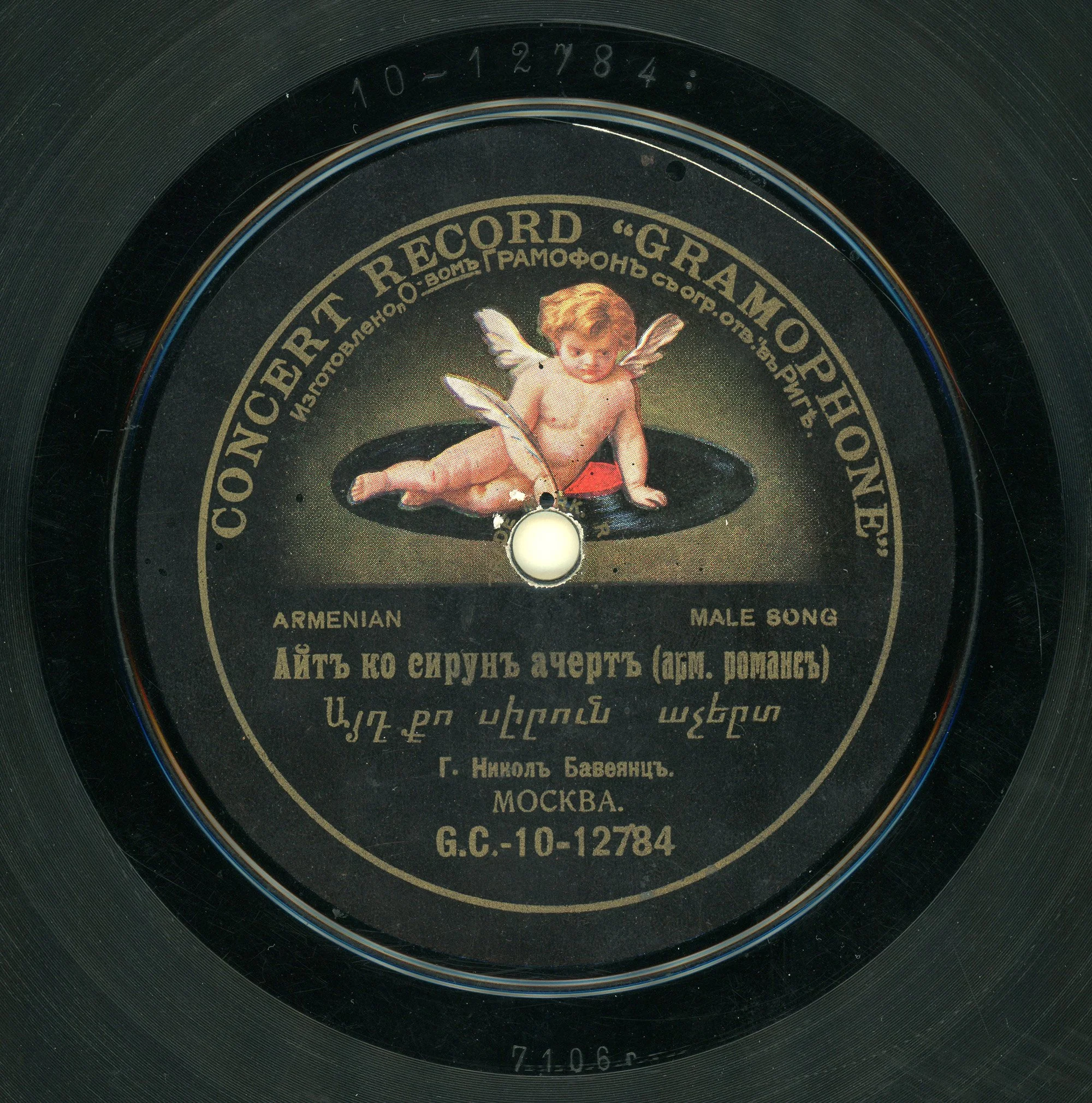
Today we look at one of the oldest and scarcest commercial recordings of Armenian music in the Museum’s collection. The record was made in Moscow in 1909 and features a largely unknown Armenian singer and tar player named Nikol Baveyan. The recording takes its place among some of the earliest Armenian music recordings, made in the first decade of the 20th century and produced by the London-based Gramophone Company. This record's presence in the collection of the Museum is a product of the ad hoc record import and distribution industry which flourished in the United States in the first decades of the 1900s. Thanks to the presence of this industry and the distribution of what are now exceedingly rare artifacts of the first years of recorded Armenian music, we are privileged to have a glimpse into the musical culture of the ashugh tradition of the Caucuses.
Given that many recordings of Armenian performers made by the international labels in the first decades of the 20th century were recorded in Constantinople, the bulk of recordings which were imported to the States and have survived to make their way into the collection of The Armenian Museum of America represent Western Armenian output in a late Ottoman context. This makes the very earliest recordings made in the Caucuses particularly precious for their representation of the Eastern Armenian musical practices in the pre-Soviet period. Other artists who recorded in the Caucuses in this period include actor Hovhaness Abelyan, as well as the renowned composer and ethnomusicologist Komitas Vardapet, who recorded his first records in Alexandropol/Gyumri in 1909—the same year that Mardiros Der Sarkis Tashjian made the first Armenian language recordings here in the States. Within this context, what makes the recording of Nikol Baveyan stand out is the way it ties into the ashugh practice and repertoire of the late 19th century in the Caucuses.
While we have no biographical information on Baveyan, thanks to the Gramophone Company discography and the work of collector and researcher Jonathan Ward, we do know that the recording shared here was recorded by the engineer Max Hempe in December 1909 in Moscow. According to the work of discographer Dr. Alan Kelly, Beveyan recorded at least another 9 sides over two recording sessions in May and August of that same year in Tbilisi. Several of these recordings were later reissued by French Pathe.
The instrument on which Baveyan accompanies himself is the tar, a long neck lute of Persian origin with metal strings and a skin top which was very popular in the 19th century Caucasus. You can read more about the instrument and its later use in the recorded output in the US. But in the case of this example, what is most relevant is the instrument's place in the tradition of the Armenian ashughs of the Caucuses in the late 19th and early 20th century. In simplified terms, the Ashugh was an itinerant troubadour, poet, story teller, and composer, most popularly represented in Armenian culture through the iconic Sayat Nova. In the period of this recording, the Ashugh tradition was still practiced and these artists were still responsible for contributing many of the popular compositions of the day. Among the more renowned Ashugh of the time was Ashugh Sheram (who in fact was the composer of the tune Zov Kisher, which Baveyan records on our record under the title Ayd Koo Siroun Acherit). Ashugh Sheram, who was born Grigor Talian on March 20, 1857 and died March 7, 1938, was an active contemporary of Baveyan and himself recorded for Pathe in 1911. Two of those recordings can be heard here. The fact of Sheram and Baveyan both recording in Ashugh tradition along with their tar—and further that Beveyan recorded a tune composed by Sheram himself— gives us a glimpse into a period in the Armenian communities of the Caucuses where the ancient practice of the Ashughs was still a vibrant part of the contemporary popular music culture. The other song on this disc, titled Azniv Unger, Meranoum Em (Kind Friend, I Am Dying) is a patriotic ballad which was once very well known but today is little played. Interestingly, the song is performed by the Tashjian Brothers on one of their records in the same period.
This recording's significance lies in its position within the specific and fragile lineage of the earliest documents of Eastern Armenian musical practice, captured in the Caucasus alongside the contemporaneous work of Sheram, Komitas, and others. It offers a rare window into a pre-Soviet moment when the Ashugh tradition was not yet a historical curiosity but a living, working part of popular musical culture. That such a recording survived the ad hoc networks of import and distribution that carried it from Moscow to Massachusetts, and that it can still be heard and studied today, is a reminder of how much of this history depends equally on chance as it does active preservation.
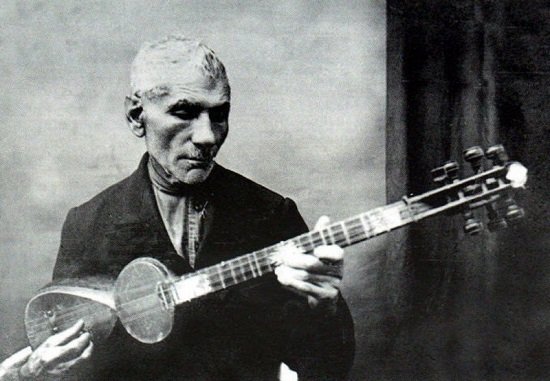
Portrait of Gusan Sheram (Grigor Talyan), composer of the song Zov Kisher and contemporary of Nikol Beveyan, with his tar. (Image Source: Music of Armenia via Armenian Wikipedia, wikipedia.org)
A special thanks to the SJS Charitable Trust for their generous support of our work to digitize and share our collection of 78 rpm records.
