
MG Parsekian: Producer and Pioneer
Written By Jesse Kenas Collins
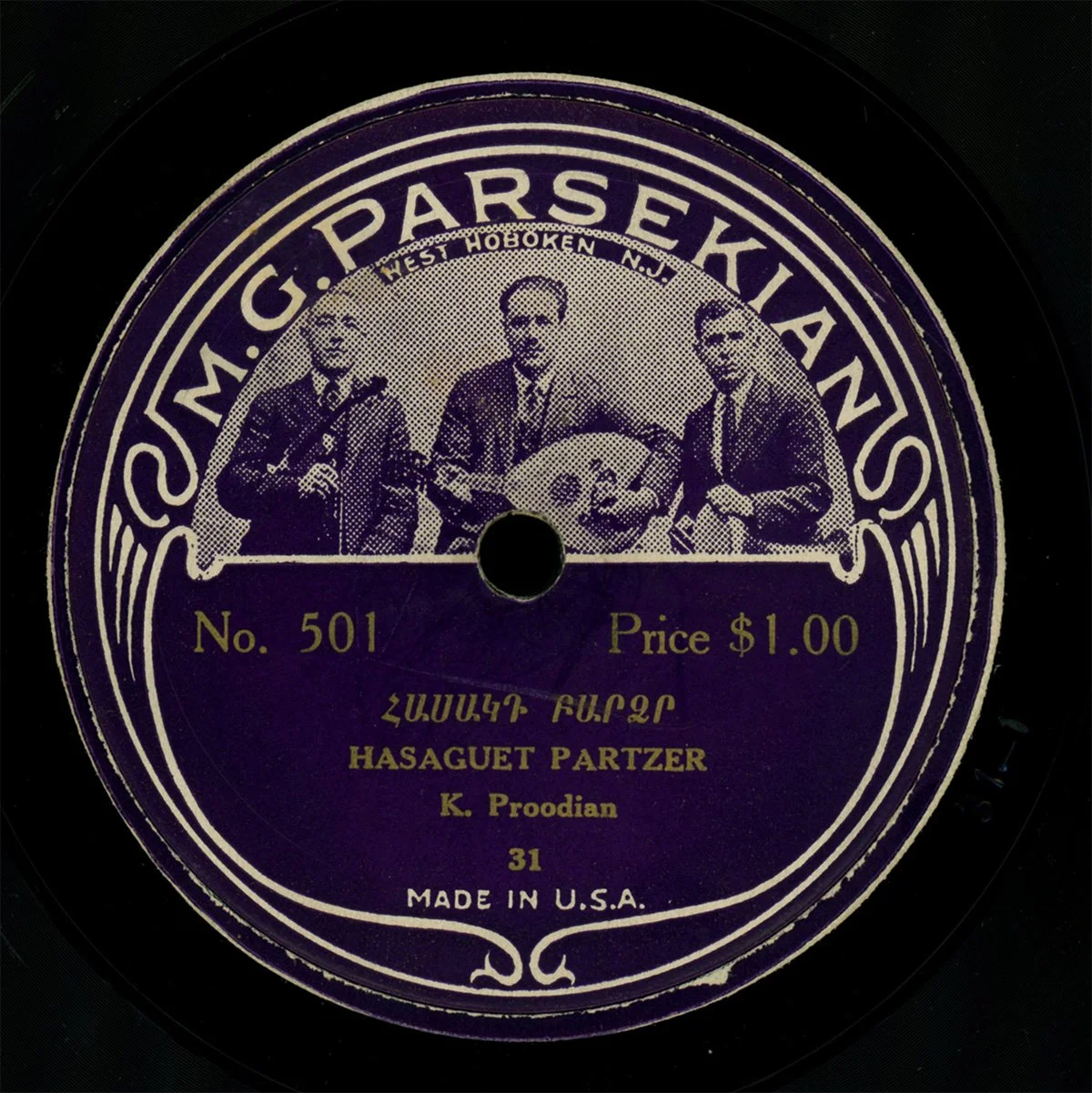
Mgrditch George Parsekian is a name that stands out in the history of early Armenian recordings made in America: it sits abbreviated as M.G. Parsekian atop the crest of the beautifully designed art deco labels from his record enterprise of the early 1920s. While not a performer himself, Parsekian took a central role in facilitating some of the first Armenian music recordings to be made in the States, initially through Columbia Records, later through his own independent label, and later still as his catalog was republished through affiliate labels. It’s through his efforts that we are left with a depth of recordings made by numerous artists of the period, many of whom we have featured here before, including Karakin Proodian, Hovsep Shamlian, Mesrob Takakjian, and Megerditch Douzjian, among others. Along with this article we have included recordings from the Museum’s collection on Parsekian’s label, which represent songs recorded by the aforementioned artists (but which were not previously included in their respective articles).
Born in Dikranagerd in May of 1883, Mgrditch Parsekian emigrated to the US in 1897, and by the age of 18 had settled in New Jersey, where there was an established enclave of fellow Armenians (also largely from the region of Dikranagerd). It was there, working as a salesman, that Parsekian began to operate as a records dealer, leveraging the existing Armenian audience in the NY and NJ area. By 1907 he was running advertisements for records being sold out of his shop in West Hoboken. Just a few years later his work expanded into that of a producer, pulling from the pool of working musicians in the local community, including the popular vocalist Karekin Proodian. His first venture as a producer came in 1912, only three years after Mardiros Der Sarkis Tashjian made the first Armenian-language recordings on Columbia Records. At the time,Columbia offered recording services to individuals and small groups for a fee. This is likely the model under which the Tashjian’s produced their recordings; being aware of this service, Parsekian first arranged sessions for his stable of musicians. In the fall of 1912 he paid to record and press 24 songs, primarily sung in Turkish by Armenian musicians and published under Columbia's E series, which was dedicated to foreign language material. Notable among these sessions is the Armenian-language recording of Karekin Proodian singing Ov Dzidzernag and Im Hayrenik, which we have featured previously. The recordings on Columbia circulated extensively through the existing network of largely Armenian-owned record dealers and small shops throughout the Northeast.
On the strength of these first recordings and through the network of stores bringing these and related import records to market, Parsekian expanded his operation in 1923, establishing his own MG Parsekian label. This kind of enterprise was becoming more feasible as the cost barrier to recording technologies lowered Parsekian’s company opened on the heels of a cohort of other Armenian musicians and entrepreneurs who had just established similar operations (including Vartan Margosian’s Margosian A&T Records and Sarkis Sarafian’s Sohag Records). The sessions for most of these independent labels were made in a private recording studio in either New Jersey or New York. Substantiating the exact location proves to be difficult, though we do know that Margosian had made a personal investment in owning his own equipment. The first recordings on the MG Parsekian label featured Karekin Proodian again, this time accompanied by Harry Hasekian and Edward Bashjian and featuring original contemporary songs written by Hovsep Shamlian. The records were quite a success, with an initial batch of two hundred selling out promptly.
The label put out roughly 40 records during the time of its founding up to 1926. In this period, Parsekian also worked somewhat collaboratively with the Sohag label run by Sarkis Sarafian. Prior to establishing his own label, Parsekian had served as a dealer for Safarian’s Sohag Records, and so in the model of their collective ecosystem the two labels put out joint advertisements to promote their catalogs in tandem. These advertisements also point to a shared network of manufacturing, since some ads point to the use of the pressing plant services of the Emerson Phonograph Company: records pressed in this Scranton, NJ facility appear in the same red wax across the Parsekian, Sohag, and Margosian labels.
The recordings presented along with this article represent just a tenth of the output of the Parsekian label, covering just a few years. By 1927 both Parsekian and Sohag would pass their catalogs onto the Varteresian Brothers, who had already provided recording equipment and much of the distribution for the early independent labels. This was a turning point not just for Parsekian, but for the musicians who recorded with him. Artists who appear on his discs would go on to build labels of their own, as well as record for later independent labels. For example, Hovsep Shamlian, who composed many of the songs recorded by Parsekian’s artists, would establish his own self-titled label in1927, and would create a prolific body of recordings of his own work. And Mesrob Takakjian, a master clarinetist who appeared on a number of Parsekian’s records, relocated to California and contributed to the vibrant musical culture of the area in the 1940s, with his recordings on the Kevorkian label, contributing to the clarinet-heavy aesthetic which characterized much of the Post WWII Armenian American music.
Mgrditch George Parsekian never sang or played on a single record, but his impact is felt through the body of recordings he facilitated and distributed. As one of the individuals who built the small network of Armenian entrepreneurs in the independent recording industry — shop owners, producers, dealers — he was part of a valuable cohort that kept Armenian music circulating across the country. Even after his own activities ended, his work and perspective continued to circulate both through reissues made by the Varteresian Brothers' Pharos company and through the new work of his collaborators.
*Source note: Much of the information provided here is sourced from documents gathered by Harout Arakelian for the forthcoming book Armenian 78s in America: A Discography, as well as from Canary Records’ compilation Oh My Soul: Armenian and Turkish Language Music from the Parsekian Label in New Jersey ca. 1923-26.
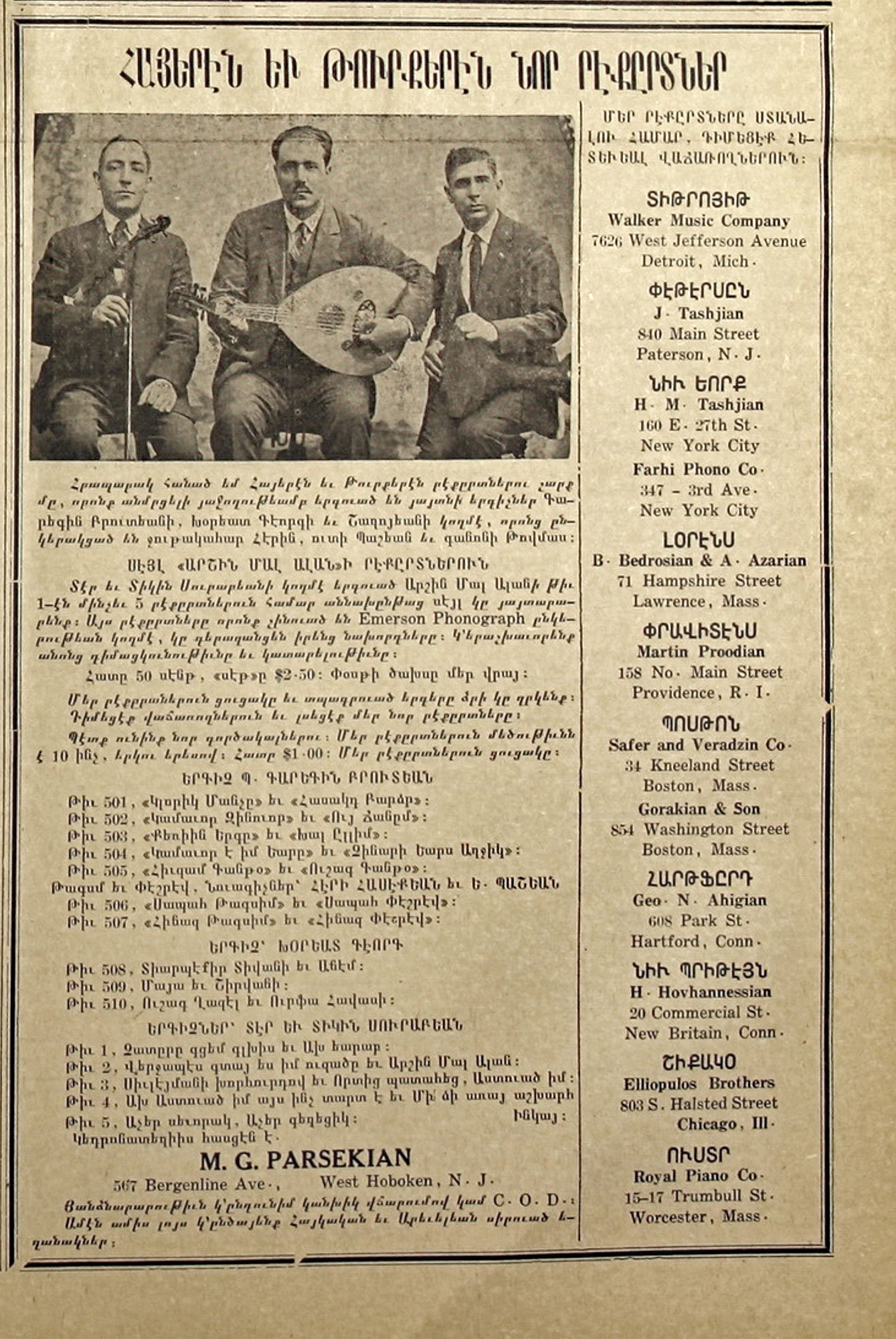
Advertisement for MG Parsekian records offering “New Armenian And Turkish Records,” run in the September 20, 1924 issue of Baikar (Image Source: National Library of Armenia)
A special thanks to the SJS Charitable Trust for their generous support of our work to digitize and share our collection of 78 rpm records.
