
Vartan Margosian: A Musical Life
Written by Alessandra Stoutner, 6th Grade, Age 12
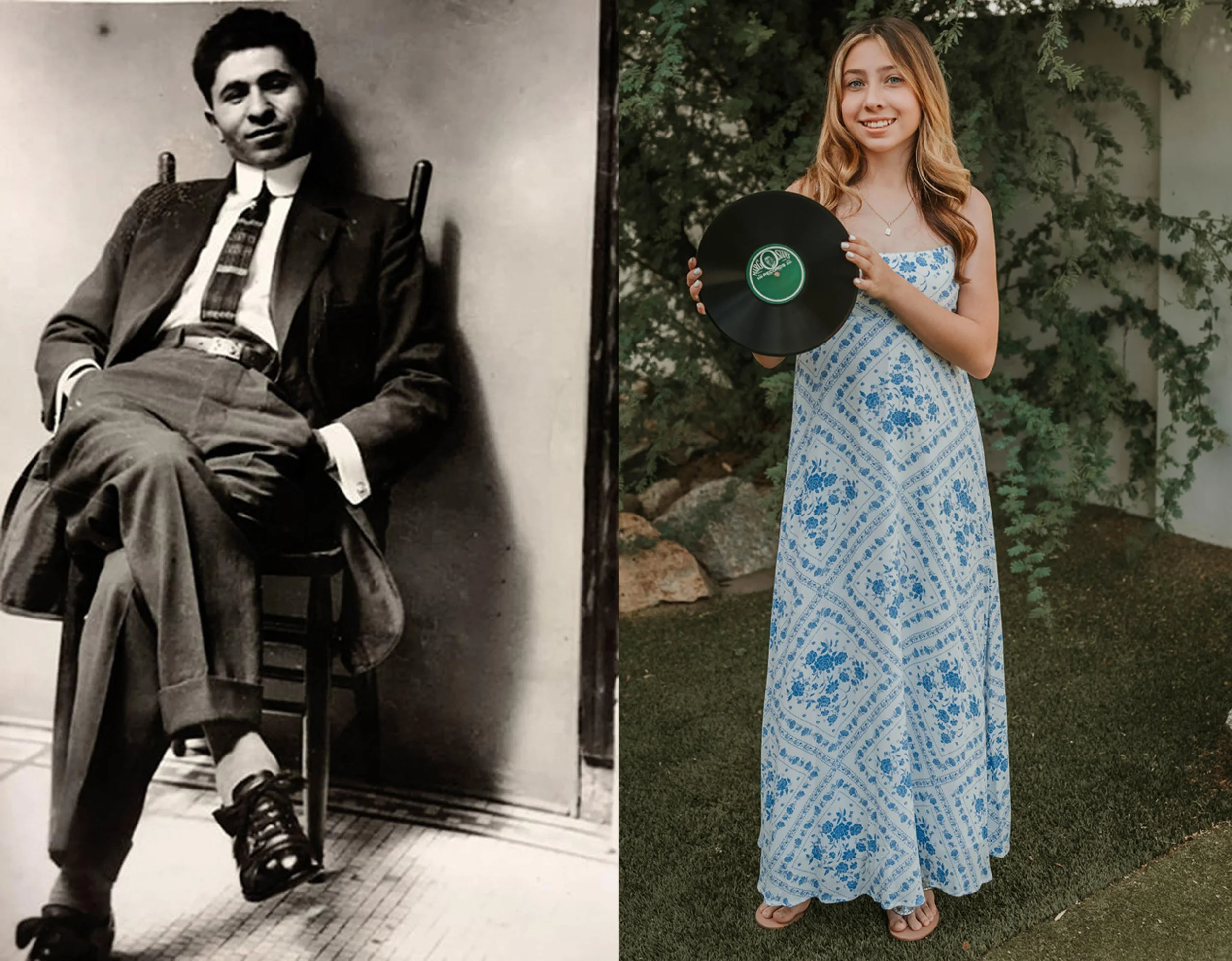
Portrait of Vartan Margosian (left) and Alessandra Stoutner (right), this essay’s author and Vartan’s great-great-grandaughter.
In this edition of the Sound Archive we revisit the life and work of Vartan Margosian, this time through the words and perspective of Vartan’s great-great-granddaughter, Alessandra Stoutner. The essay below was written by Alessandra as part of her 6th grade coursework this year. In addition to being an excellent read it speaks volumes to the strength and possibility of cultural preservation through the generations, and the way recorded history helps make this transmission possible. We want to extend a huge thanks to Alessandra and her family for contributing her voice to this project. We’ve included several recordings not included in our previous article on Vartan. We also want to thank Ara Dinkjian for contributing a transfer of the song Azneve Enger from his collection for accompaniment with this post.
Once there was a boy who lost his home, his family, and his country, but his music stayed with him and he shared it with the world. That boy was my great-great-grandfather, Vartan Margosian. His life and music are an important part of Armenian history and culture, and my own musical journey.
My name is Alessandra Stoutner and I am in 6th grade. I am honored to be a guest contributor and share my great-great grandpa’s legacy based on my research and interviews with Mr. Harry Kezelian, who is the Assistant Director at the Alex & Marie Manoogian Museum, Mr. Harout Arakelian, discographer and scholar, my grandmother, Ms. Sherry Margosian Stoutner, and with the support and encouragement of my 6th grade humanities teacher, Ms. Sandra Flayton.
Vartan Margosian was born on January 9, 1891, an ethnic Armenian in the Ottoman Empire. His small, rural Armenian village, Sheikh Hadji, was on a main thoroughfare, near the Upper Euphrates River and a large mountain. The people there were better educated and connected to the outside world because of regular contact with travelers and American missionaries. The village was filled with family and friends. Two churches rang bells across town every day, and Armenian folk music was a part of Vartan’s daily life. However, at this time, Armenians were treated as second-class citizens and village inhabitants increasingly faced persecution.
In 1908, Vartan fled growing discrimination and danger, and made his way to America through Marseilles, France. He traveled with almost nothing but his violin and the music that preserved the memories and traditions of the home he left behind. He would never see his country again in his lifetime. Within a few years, most of his loved ones were killed and his village was destroyed. Today, a dam constructed by the Turkish government has flooded the majority of the ruins of Sheikh Hadji.
In New York, Vartan found work in the detailed and artistic trade of photo engraving. He married Estella (Asdghigs) in 1915. This same year, the Armenian Genocide began in the Ottoman Empire. Over a million Armenians were violently killed or died of starvation and exposure during this time, including most of Vartan’s family and those in his village.
As reports of the Genocide’s atrocities reached America, I imagine Vartan felt a profound heartbreak. He must have yearned for his village and carried a lasting sorrow for the world and the people he once knew. In a courageous act of preservation for his family and for surviving Armenians, I believe this is when Vartan decided to share both his own original music and the music of his homeland with the world.
At the time, music was one of the primary means of communication and expression for Armenians in this country. There were no movies featuring Armenians and few known Armenian visual artists in the United States. Vartan must have understood this. By 1921, he saved what would be thousands of dollars in today’s money to purchase the most modern recording equipment available (a phonograph recording machine). He then set up his own recording studio.
Vartan opened a small privately-owned record company to independently record and release traditional Armenian music (A&T Records, later Margosian’s Records). Before Margosian’s Records, Victor (later RCA-Victor) and Columbia primarily recorded, produced, and distributed music. Vartan’s indie record company was one of the first of its kind in the United States for any genre of music. This was incredibly innovative and ingenious for the time.
Over a 3-year period (1923-1925), Vartan worked tirelessly in his spare time after work and on weekends to record at least 66 records and over 122 songs, with 100 to 300 copies per record release. At his own cost, he had the records pressed, probably by the Scranton Button Company. Then the records were sold by small stores throughout the United States for approximately $1.00 per record. After the cost of creation and distribution, he likely had very little profit.
Vartan was known as the “Nightingale of Kharpert” because he played, sang, wrote, and recorded traditional folk music from the Kharpert region of present-day Turkey. Vartan sang and wrote lyrics in Armenian, the Western Armenian dialect, Turkish, and Kurdish. He played violin and the oud (similar to a guitar). Vartan would often invite musicians to be on his records. In doing this he captured some of the only known recordings ever made of talented artists, including clarinet player Donabed Perperian.
Vartan was also a promoter and performer. Within six months of the creation of a radio station at Gimbel’s Department Store in New York City, Vartan played and recorded over the radio at the Store’s recording studio. He was heard on the radio station in 1924 and 1925. There are surviving newspaper ads from the 1920s inviting readers to listen to Vartan Margosian’s Armenian Trio, which used “unique oriental instruments.” My Grandmother remembers him playing at weddings and Armenian picnics or festivals called hantess in the 1950s. Vartan’s record business also followed him when he moved to Forest Hills, New York. He continued to record and perform occasionally.
Some of Vartan’s songs were original pieces he wrote and composed, while others were traditional songs he remembered from Armenia. Vartan almost always played or sang on his recordings. Vartan’s music had traditional folk melodies and tempos, and a rhythmic beat. It included multiple instruments accompanying singing such as dumbaks (drums), piano, clarinet, mandolin, oud, Kanon (like a zither), and violin or fiddle. Assistant Museum Director, Mr. Harry Kezelian described Vartan to me as a passionate pioneer who played unique music that cannot be replicated today and that came directly “from the soul.” At times, Vartan would invent lyrics or rhyme on the spot using multiple languages. Mr. Arakelian compared Vartan’s music to Appalachian Blues music because it is folk music with some elements of improvisation, and an emotional range from sad to upbeat.
A portion of Vartan’s songs are danceable, joyful, loving, and a few are even funny. Vartan would sing earthy songs about traditional Armenian life or life as an Armenian in America. In his ode to his home village, Sheik Hadji, Mr. Arakelian translated lyrics which recalled the village churches’ bells, “Whomever tolls the bells lifts my heart up.”
Mr. Arakelian also described that at times Vartan would blend the modern and traditional in his music. Sometimes he would modify older lyrics to make them more contemporary and include references to the United States. This can be heard in Nazli Detroit, a song about an Armenian woman in Michigan, and in Mer Khuntsorin, where Vartan tells the story of an Armenian man in New York whose love moves away to Boston.
One of his most famous songs is a love song about an apple tree titled Emyaress, which translates to “My Love.” It was originally recorded in 1923 and is one of Mr. Kezelian’s favorite songs. It is an excellent example of Western Armenian rhythm. It went on to be covered by multiple later musicians including Harut Merab, and it is still popular today.
Other songs by Vartan discuss sorrow, the deaths of Armenians, and his longing for his Armenian home. They are deep, heartfelt mourning songs. I felt such sadness when Mr. Kezelian and Mr. Arakelian shared some of Vartan’s translated lyrics about the Genocide. In the song Darsim, Vartan sings to God and fate about the massacres of Armenians, saying in Turkish: “Before my chicks could fly away, you burned my nest.” In another song titled Azniv Unger, translated to “My Fair-Weather Friend,” a favorite of Mr. Arakelian, Vartan sings directly to the Euphrates River. He describes it as running with blood and asks the river to care for his parents and brother who died.
Mr. Arakelian explained to me that Armenians, but also Kurdish, Turkish, Assyrian, Jewish, and Greek people in their countries and in the United States enjoyed Vartan’s music. I imagine the people who listened to him. I can see housewives playing his songs while they cooked and cafes putting his records on their phonographs. I think his lighter music reminded them of happier times, and they shared Vartan’s sorrow when he was nostalgic and sang about loss.
One of my favorite details about Vartan’s records is that at the start of many of his recordings, such as the song Jezaier, you can hear Vartan speak. He quickly says the name of his record company and sometimes the song name. It is amazing to me that more than 100 years later I can hear my great-great-grandfather’s speaking voice so clearly in those moments.
For a time Vartan and Estella lived in a duplex with my Grandmother, her brother, and her parents in the same house in Forest Hills, New York. My Grandma described Vartan as a “jovial person” who was funny, easy to get along with, and universally loved. This was obvious at their 50th wedding anniversary party, which was filled to the brim with his many friends. He was remarkably positive with a big heart, and he never discussed his past hardships. My Grandmother said, “he was meticulous” and a true perfectionist in both his work as an engraver and his music. She remembers him reading the newspaper with a magnifying glass to study the fine details of the photo engravings and compare them to his own work. He also loved the outdoors and gardening. She recalled that he once planted a small clipping from an Armenian fig tree and nurtured it until it grew into a towering, three-story tree that produced fresh figs for the family.
Music was always a part of Vartan’s life. Even when he was much older, my Grandmother and her brother would sit in the home’s basement on rolled-up Oriental rugs and watch Vartan walk around the room while playing his violin. Vartan would record his music on a reel-to-reel tape player, repeatedly playing it back to correct any portions he did not like until he was satisfied. Sadly, Vartan passed away in 1965 at the age of 74.
Vartan spent less than 17 years in his Armenian village.Yet, he carried the soul of his homeland with him his whole life. He likely had no formal musical training, and he was proud of who he was, where he came from, and what he could do. Vartan poured his memories and his traditions into music that he shared with the world. This was a true labor of love because he made virtually no money from his recordings, and instead did this to preserve the music, language, and culture he loved. The importance of his work is clearer now more than ever. As Mr. Arakelian explained to me, Vartan’s language (Western Armenian dialect) preserved on some of his records is on the verge of extinction and may disappear entirely within the next 50 years. His recordings in this dialect will assist future researchers in learning about this language when it is no longer used.
I see Vartan as a passionate hero, someone whose work was selfless and authentic. He preserved the voices of those silenced by the Armenian Genocide, as well as the language, traditions, and music of Western Armenia, Armenian immigrants in this country, and musicians who might never have been recorded. Because of Vartan’s work and Margosian’s Records, they are all remembered and will endure for future generations.
When I interviewed my Grandma for this essay, she told me that to be Armenian is to have an instinctive drive to be creative and do things beautifully. This was certainly true of Vartan. A century ago, he poured that drive into making and also preserving beautiful Armenian folk music. I am Vartan’s only great-great-grandchild, and I am also a musician. Every time I play piano, guitar, or sing, I feel a connection to my Armenian heritage and to him. Through his surviving music, and through me, Vartan, his lost homeland, his family, his friends, and his experiences live on.
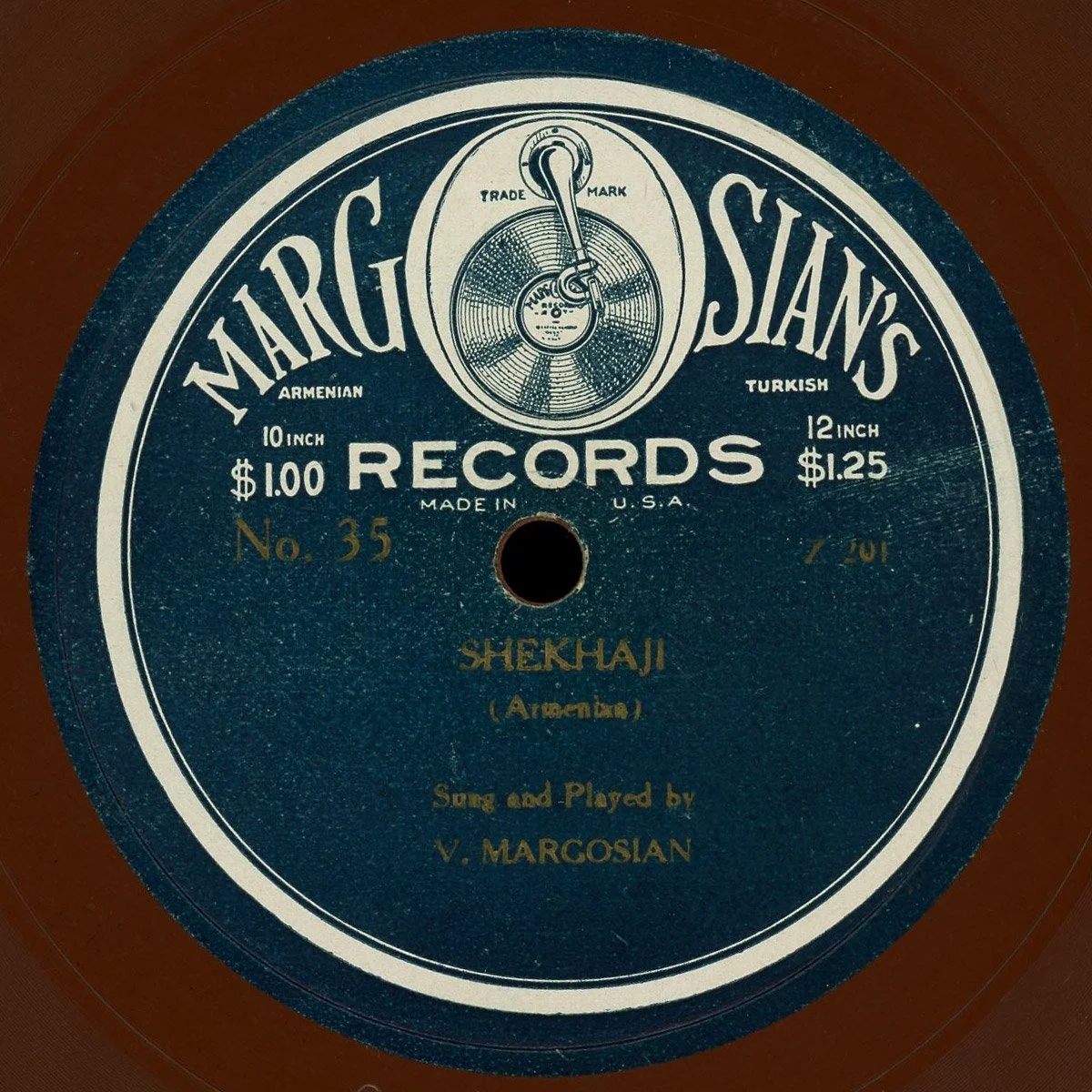
A special thanks to the SJS Charitable Trust for their generous support of our work to digitize and share our collection of 78 rpm records.
