
Marie Arakian – The beauty of her strength
Written by Harout Arakelian
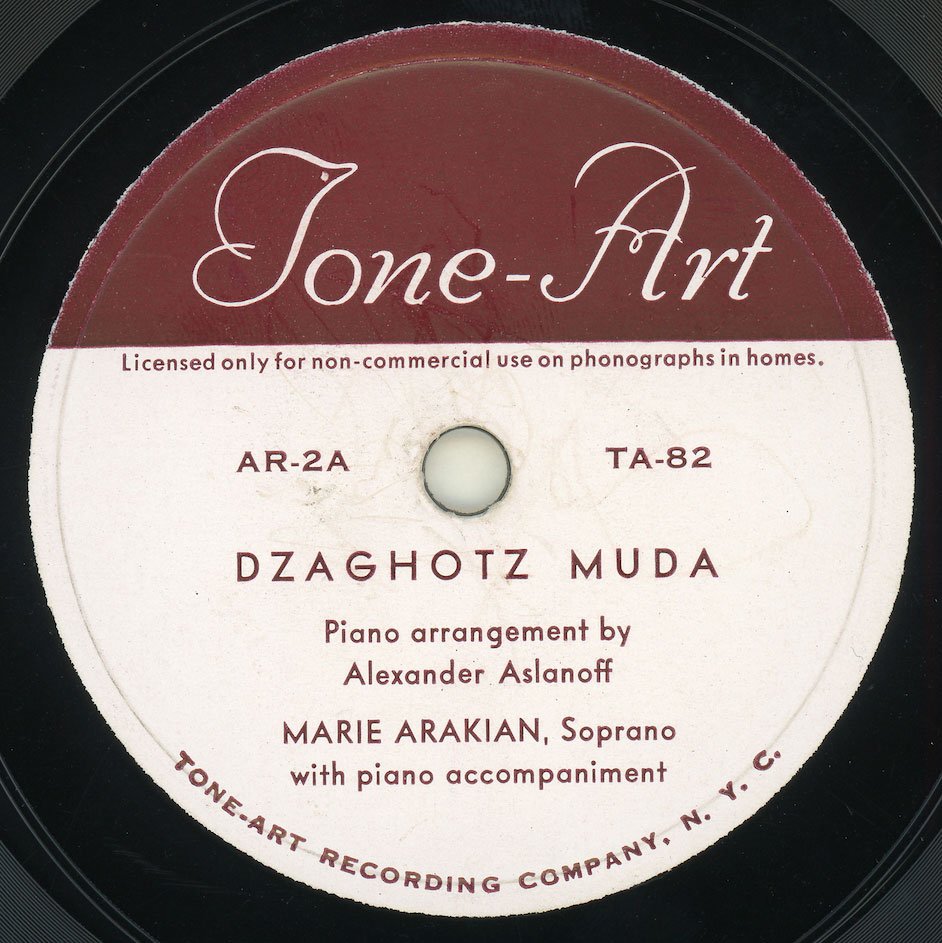
“A glorious voice of the type which belonged to the great coloratura singers of the past was disclosed by Marie Gabriel Arakian, Armenian soprano…Tones of such purity and power, such evenness of quality throughout a long compass, are among the rarest phenomena to be found on the concert or operatic stage today.”
Marie Arakian’s recording career began in 1942, and her young career steadily climbed toward stardom. By the time of these recordings Arakian had become a significant artist in the Armenian-American community. In the early 1930s, Arakian was appearing not only at Armenian cultural events but also on American radio. In 1932 she was featured as a soloist with the Armenian National Musical Society under the direction of composer and conductor Grigor Suni, in a broadcast over WABC and the Columbia network. In 1934, she was invited to sing four Armenian folk songs at an event organized by the Armenian Students Association and the Armenian Scientific Association of America in New York City. Throughout the 1930s, Marie continued studying with orchestra leader Alexander Aslanoff, the former conductor of the Russian Imperial Opera in St. Petersburg. Aslanoff was born in Baku in 1874, and arrived in the United States in 1932. Together with Arakian, they had numerous concerts and performances produced and in 1942 held a recording session.
Following her debut performance at New York’s Town Hall in 1939, Arakian’s star appeal continued to bloom throughout the 1940s. Like many of her contemporaries she filled the music halls wherever she performed; for example, a concert in Detroit, Michigan was attended by over 400 people.[4] In New York, she would share the stage with young up-and-coming artists Maro and Anahid Ajemian. And throughout the years she continued performing with the Armenian National Chorus.
The Gramophone Record Supplement published a notice of a set of her Armenian folk-song recordings: two ten-inch records containing four sides. The repertoire included “Kroong,” “Golkhozi Agshig,” “Dzaghotz Muda,” “Yaili,” and “Hoy Nazan,” arranged by Aslanoff. The listing stated:, “The singer has a well schooled voice of pleasing quality, and we are informed that Sergei Rachmaninoff has complimented both Miss Arakiain and Mr. Aslanoff for their fine work. The recording is very good.”
In 1948, Arakian travelled to California for a series of performances in Los Angeles and Fresno and for a family reunion in Fresno. Unfortunately, prior to the visit, Marie was in a terrible car accident. She diligently continued her performances with the assistance of crutches, but the physical toll limited her opportunities. That particular visit inspired her 9-year-old niece to pursue a career as a singer, as Edna Garabedian describes: "sitting in the back row in Warnors, hearing my aunt doing a whole concert, on crutches," Garabedian said. "She sang in other recitals, always on crutches. The beauty of her strength, surviving to sing on stage, impressed me. I knew from the beginning I needed some way to carry on for her." Edna has had an illustrious career herself and in 2000, she founded the California Opera Association.
As Marie Arakian’s career on stage continued with great success, her recorded output remained scarce and limited to a few recording sessions. Other than her 1942 sessions for the Tone Art label, she later recorded one side for Haig Ohanian’s High-Art Records, a rendition of “Hoynar” (most probably recorded in Detroit in the mid-1940s). During her concert series in Los Angeles, Arakian also recorded two songs for the Armenian owned Rec-Art label, accompanied by Eunice Ferrahian, Der Getso and Garmir Vart.
By the 1950s, Marie Arakian settled down in Detroit and continued her musical career on stage while also tutoring young vocalists. While her illustrious career could have fizzled into obscurity, her contributions to the legacy of Armenian-American music remain as important historic artifacts from a past era. As stated in the 1948 Los Angeles Times article, Marie’s voice and musicianship should be studied, explored and appreciated:
“Aspiring singers would do well to take a lesson from Marie Arakian in thorough musicianship and an intelligent concept of vocal problems.”
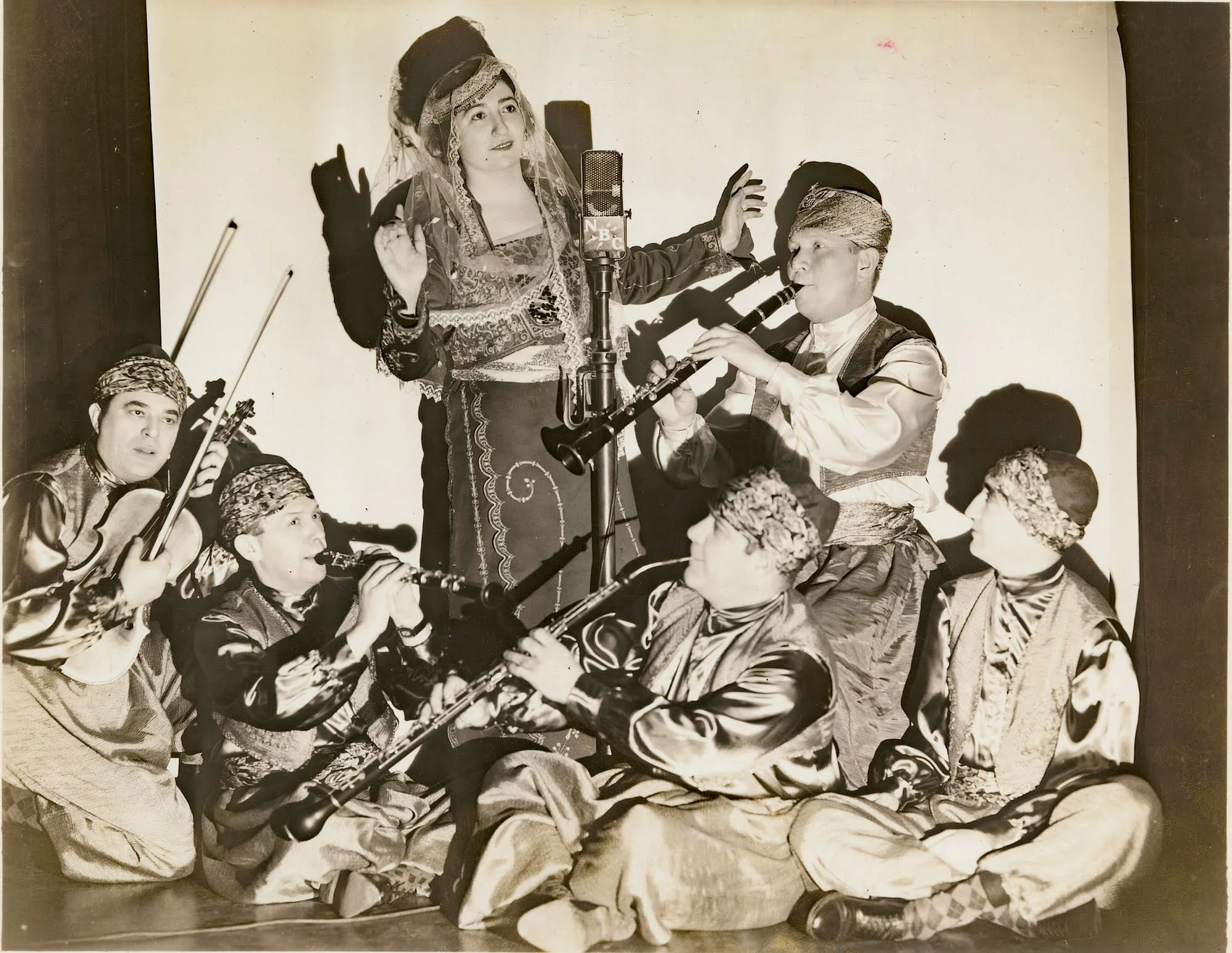
Marie Arakian and orchestra in orientalist costumes, circa 1938-1960. Photo by Ray Lee Jackson, NBC studio, New York, New York. (Image: Project SAVE Armenian Photograph Archives, Courtesy od Danielle Hatchadoorian Rydber)
A special thanks to the SJS Charitable Trust for their generous support of our work to digitize and share our collection of 78 rpm records.
