
Moorad Elanjian: The Miami Beach Recordings
Written by Harout Arakelian
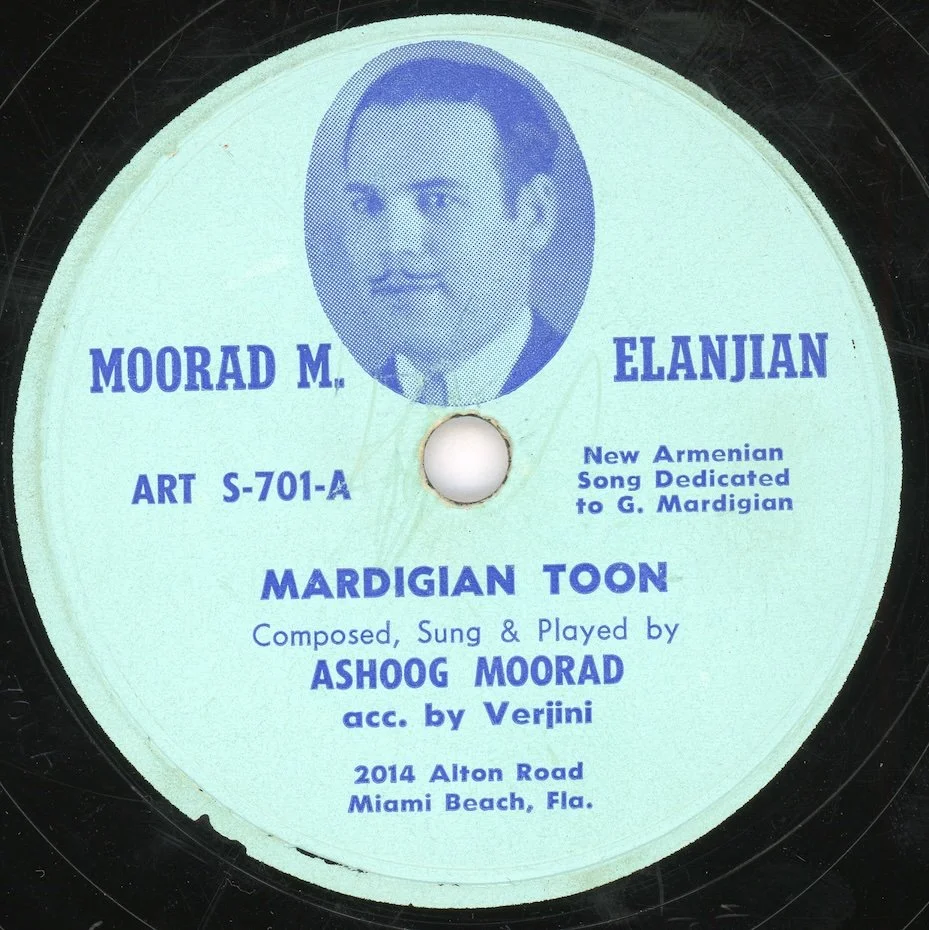
The Sound Archive focuses on historic recordings by Armenian musicians, but over time, it has also, perhaps unknowingly, documented the geography of Armenian communities across the United States. From Worcester to Los Angeles, and many cities and towns in between, the recordings offer glimpses into places where Armenians settled and built their communities.
This article takes us to the South for the first time. Florida's Armenian community began to take root in the 1930s, as families settled in areas including Hillsborough and Miami Beach. The consecration of Florida's first Armenian church in 1953 provided a center for religious and community life. Meanwhile, Miami Beach's hotels, nightclubs, and resorts created a different kind of environment in which a musician and entrepreneur might operate.
In 1954, a set of ten songs was recorded in Miami Beach, Florida, by a musician who operated a small hotel while also working as a tailor in a department store. Born in Arapgir, Ottoman Empire, on January 15, 1904, Moorad Elanjian’s path to Miami Beach was far from direct. His family moved to Adana, Cilicia, and likely relocated to Sivas due to the anti-Armenian pogroms of April 1909. During the Armenian Genocide, they found refuge in Europe before eventually making their way to North America. The family settled in Cuba, where Elanjian spent much of his youth amid a mix of cultures and a lively music scene. We don't know whether those sounds influenced his Armenian songs, but they were part of the world he knew before he left Cuba for the United States in 1937. He entered through Ellis Island and settled in Cambridge, Massachusetts. The following year, he married Heranoush Soukoian, and in 1940, his son George was born. The marriage ended in divorce in 1947 or 1948. Interestingly, on his naturalization papers, he listed his full name as “Kachadour Elanjian aka Oudi Moosheg James Elanjian.”
Living in New York City in 1949, Moorad Elanjian continued his musical activities. An advertisement he placed in Boston’s Hairenik newspaper announced that the Gaidzak Orchestra had been making plans to perform “not only all types of Armenian tunes but also American dance music.” In 1954, while living in Miami Beach, Elanjian produced a set of five 78rpm records while working as a tailor and running a small hotel. Recording under the name Ashoog Moorad, Elanjian wrote, composed, produced, and performed the ten songs, with vocalist Verjini accompanying him on every song. In his advertisements, he described his music as “new, cheerful, folk style songs.”
Elanjian’s first recording was dedicated to George Mardikian, America’s first celebrity chef and a prominent Armenian-American humanitarian and philanthropist. Titled Mardigian Toon (Mardikian, You), the song offers a glimpse into Mardikian’s life and accomplishments. By 1954, Mardikian was known not only for his success as a chef, but also for his contributions to American life. He served as a food consultant to the U.S. Army, receiving the Medal of Freedom from President Truman in 1951. Alongside attorney Suren Saroyan and Brigadier General Haig Shekerjian, he helped establish the American National Committee to Aid Homeless Armenians (ANCHA), which worked to help displaced Armenians resettle in the United States after World War II. The song even names the television program This Is Your Life and its airdate, May 5, 1954, with Elanjian singing: “Medz hargankov pem hanetzin” (With great respect, they brought you on stage). George Mardikian has also been featured in previous Sound Archive articles, including: NBC Broadcast: Voice of Armenia and Louise Danielian: Armenian Songs for Everyone.
The three accompanying songs offer a closer look at Elanjian’s songwriting, with lively folk-style melodies, and clever, playful lyrics. From the flirtatious wordplay of Toon Yegar (You Arrived) to the jovial Artzate Churer (Silvery Waters) and Hampoorem (To Kiss), these recordings demonstrate Elanjian’s ability to write cheerful Armenian songs that invite listeners to enjoy both the dance music and the words.
After the five records released in 1954, Elanjian produced a sixth, this time without Verjini. One side features Elanjian performing an improvisation on the oud, while the other contains a song praising Armenian revolutionary General Dro (Drastamat Kanayan). Across the six records, Elanjian recorded twelve songs, leaving behind a small but distinctive musical legacy.
By the early 1970s, Moorad Elanjian had retired and relocated to Fresno, California. On November 6, 1981, he married Virginia Dalton (née Boyajian), but died just a couple of months later, on January 11, 1982. While his obituary made no mention of his musical contributions, his six records preserve the twelve songs he recorded, reflecting his talents as a songwriter, vocalist, and oud player.
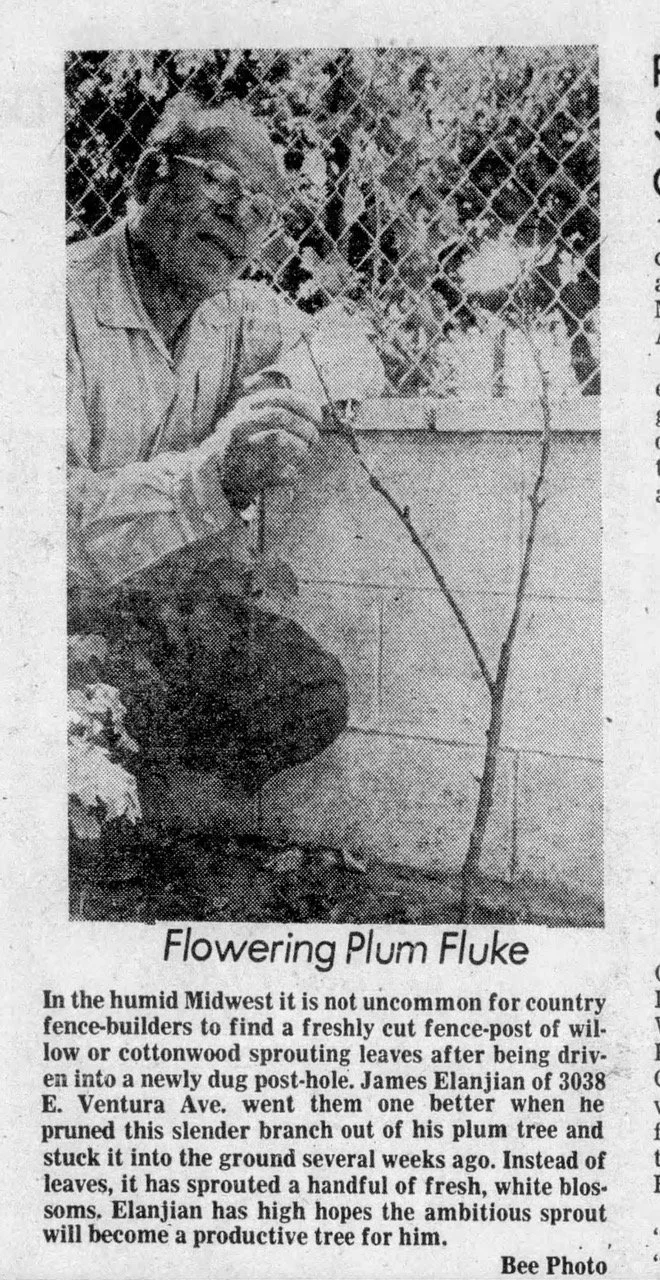
Portrait and news clipping of Moorad Elanjian along side a plumb tree at his Fresno home, published in the October 13th 1974 edition of The Fresno Bee (Image Source: Newspapers.com)
A special thanks to the SJS Charitable Trust for their generous support of our work to digitize and share our collection of 78 rpm records.
