
Kanouni Garbis Bakirgian: Master and Mentor
Written by Jesse Kenas Collins
Many of the artists featured in this series serve as vital musical links between generations, transmitting deep knowledge of their traditional repertoire through recordings and personal relationships. Like our recent feature on the renowned Armenian oud player Udi Hrant, Garbis Bakirgian, known as Kanouni Garbis, was a master of his instrument, with a distinguished career in the early 20th century across Turkey and the Middle East. After settling in the United States in the 1920s, his recordings and collaborations with other master musicians had a lasting impact on the music heard in Armenian homes and community events through the 1940s and 1950s. In his later years, Garbis further ensured his legacy by mentoring a young Richard Hagopian, who would go on to shape Armenian music in America, in a spirit closely aligned with Garbis’s own work.
Garbis was born on February 20, 1884, in Brussa (Bursa), a city with a deep Armenian cultural and musical life in the late Ottoman period. His formative musical training took place at the Armenian Cathedral of Brussa, where he studied under Bishop Arasharuni, the Primate of Brussa. In this period Garbis absorbed not only sacred repertoire but also the scales, aesthetics, and instrumental technique of late Ottoman popular and classical music. The cathedral served as an important incubator for musicians of his generation, grounding them in tradition while preparing them for broader musical careers. In 1902, Garbis moved to Istanbul, where he served as a deacon and soloist for Archbishop Maghakia Ormanian, the Armenian Patriarch of Istanbul. At the same time, he became active in the city’s vibrant ensemble scene, performing both as a singer and as a kanoun player. His mastery of the instrument earned him the honorific title “Kanuni.” These years in Istanbul placed him in close contact with leading musicians of the era and solidified his reputation as a refined and authoritative performer of the repertoire. This musical grounding in both Armenian liturgical and Ottoman music would shape the range of and approach to his musical practice for the rest of his life.
Between 1909 and 1911, Garbis was conscripted into the Turkish army and sent into mountainous regions to perform hard labor, a harsh and disruptive chapter in his youth shared by many of his generation. After surviving his time in the military he resumed his musical life, forming and leading an ensemble which toured throughout the Middle East. By 1914, he had settled in Izmir, where he taught at a girls’ music school. In 1919, he married Takoui Yeramian, and two years later, amid the persecution of Armenians, the couple emigrated to the United States. The couple arrived in 1921, first settling in Providence, Rhode Island, then Waltham, Massachusetts, before finally establishing themselves in New York City by 1928.
It was in the 1920s that Garbis’ recording and performance career in the United States began. As early as 1922 he began to perform at Armenian events across the East Coast, in collaboration with musicians including oudist Marko Melkon and violinist Harry Hesekian, both of whom would become longtime collaborators. Many of these appearances were promoted through the recorder dealer Hrand Markar Tashjian, and it was through collaboration with Tashjian in 1926 that Garbis made his earliest recordings for his own Stanboul Records label; appearing with Garbis on these recordings is violinist Harry Hesekian. The group's rendition of Tamzara and Yar Ouneyi Tachenar Boyov released on this label are presented here.
From this time and into the 1940s, Garbis was active on New York’s 8th Avenue scene, a small network of clubs at which a group of master musicians from mixed ethnic backgrounds performed music in numerous languages — the common denominator was a shared musical repertoire and experience as refugees from the regions of the former Ottoman Empire. Alongside these clubs were a suite of record labels, namely Metropolitan and Balkan records, which were prolific in publishing recordings by this cohort of musicians. These recordings circulated widely within Armenian communities and played a crucial role in forming the musical soundscape of the communities as they rebuilt their lives here in the States. One such record published by Metropolitan Records and featuring Garbis is Edward Boghosian's The Citizen, which we have included here. Like much of Boghosian’s work the song is a satirical tune that both exemplifies the musical aesthetic of Garbis and his peers, while also talking directly of the tensions and difficulty of the immigrant experience in America.
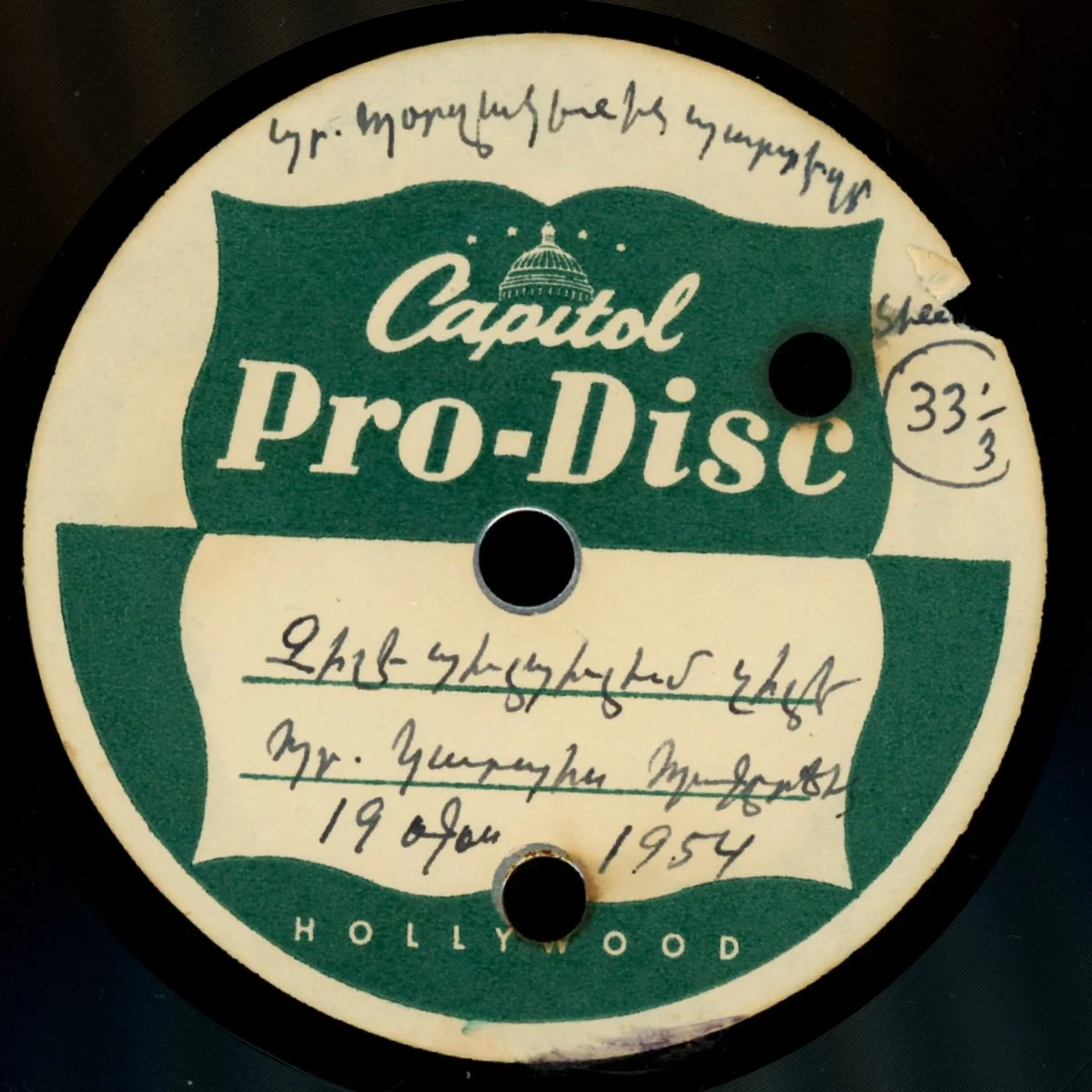
In 1949, Garbis retired to California. But even in retirement he remained musically active within community settings and continued to record on a smaller, more intimate scale. We’ve included here a recording from this period on Sarkisian Records, where Garbis is featured in Reuben Sarkisian’s group on the song Ieysor Yares. Garbis’s commitment to preserving and transmitting the repertoire never diminished. He made additional community-based recordings, and participated in informal home recording sessions in the early 1950s. The museum is privileged to hold a small collection of such recordings made in 1954 at the homes of friends. Though the recording quality of these home recordings is poor, they stand as precious documentation of the private musical lives and practices of those musicians who left their homeland under the most severe of circumstances and rebuilt their lives, communities, and musical traditions here in the States. In honor of that spirit and resilience we’ve included a short solo, Kanoun Taksim, by Garbis and taken from these home recordings made in August 1954 in the garden of his friend Mr. Borzagian. This intimate setting is reflected in the 1964 picture included here, which shows Garbis performing at a house concert along with his only pupil, a young Richard Hagopian. Before his passing in 1969, Garbis took on Richard Hagopian as a pupil after a life dedicated to keeping his musical heritage alive through a prolific performance and recording career. We celebrate Garbis’ foresight in entrusting Richard with the knowledge, style, and responsibility of stewardship that had defined his own life’s work.
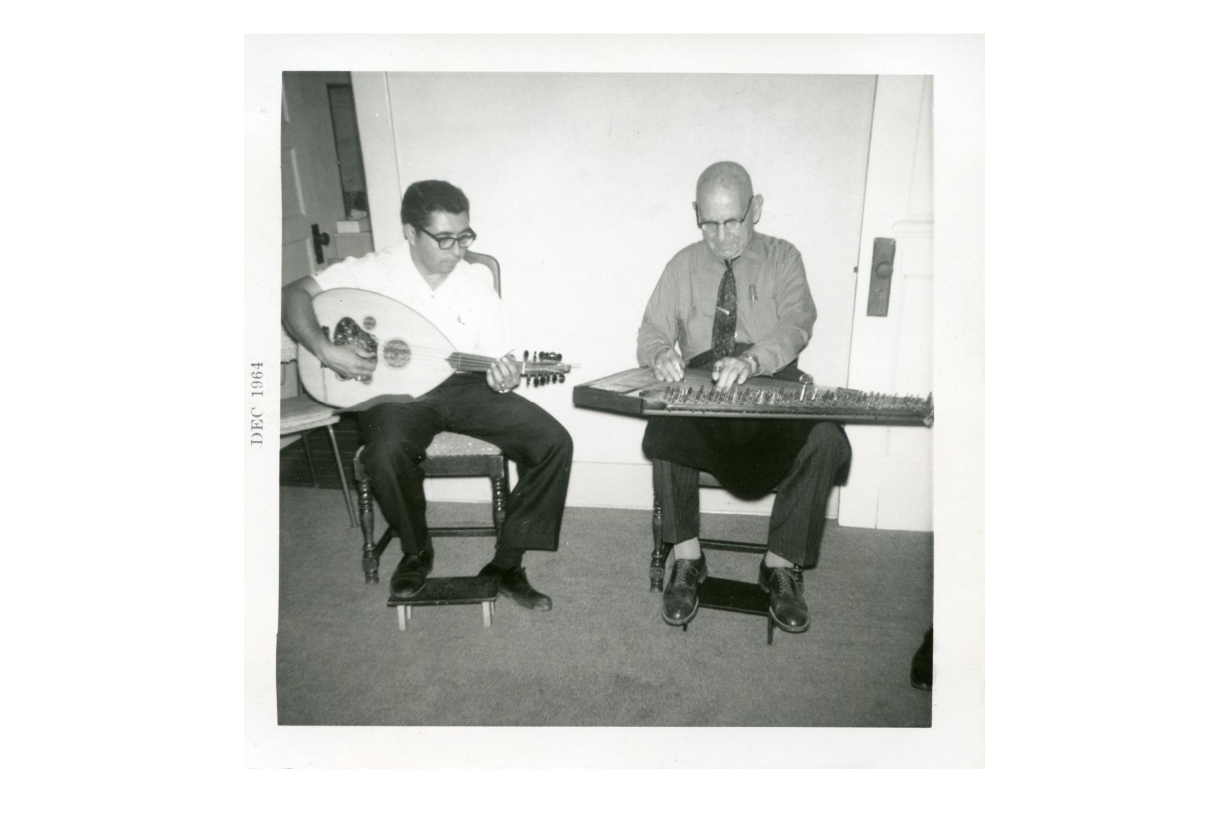
Kanouni Garbis Bakirgian and Richard Hagopian performing at a private house party in Yettem, California circa December 1964 (Image: Courtesy of Richard A. Hagopian)
A special thanks to the SJS Charitable Trust for their generous support of our work to digitize and share our collection of 78 rpm records.
