
Sound Archive
The following are selections from the museum's roughly 3,000 disc collection of early Armenian recordings and musical ephemera. Explore the links below to listen to songs, learn about pivotal musicians and see images of original records.
A special thanks to Jesse Kenas Collins, Harry Kezelian, and Harout Arakelian whose ongoing contributions of research and consultation have been critical to assembling the writings presented here.
A special thanks to the SJS Charitable Trust for their generous support of our work to digitize and share our collection of 78 rpm records.

Like Father, Like Son: The Joyful Music of Stepan and Haigaz Simonian
Among the numerous musicians from the Kharpert region that recorded for Columbia Records in the 1920s, the father and son duo Stepan and Haigaz Simonian stand out for their exuberant renditions of regional dances. Stepan Simonian was born in 1887 in Mezire and came to the United States in 1907, settling first in Haverhill, then later in Worcester, MA, where he worked as a cobbler. He and his wife Sophia Berberian, a Kharpert Assyrian, had two sons and two daughters. Their oldest son and Stepan’s collaborator, Haigaz, was born in 1909 in Worcester.

Nevart Dzeron-Koshkarian: Portrait of an Artist
Nevart Dzeron-Koshkarian, sometimes known as Nouart, was a fine artist and art educator. She was born in Perchanj, a village that was south of Kharpert. She would arrive in the United States in 1893. Daughter to engineer and author Manoog A. Dzeron, who wrote, “Nevart having received her preparatory education in Worcester and Chicago, completed a 7- year course at the Chicago Art Institute and graduated with honors as an artist. For an additional year she went to France and Italy to refine her art. She married Prof. Bedros Goshgarian. They settled in New Jersey. Nevart has always remained a patriotic Armenian. During the Near East Relief fundraising she traveled to important centers in America, lecturing on indigenous Armenian music and singing Armenian songs.
Sound Archive 2021 - Year in Review
As we enter the New Year we’re taking a look back at the artists and topics covered in the Sound Archive posts since they began in March of 2021. We hope you enjoy the selections here which bring together on one page some of the music we’ve shared to date.

Vartan Margosian, the Nightingale of Kharpert
Vartan Margosian’s style of music was unique and will probably never again be repeated. He was not a highly trained musician, and he wasn’t even a “master player” in the folk tradition. There were probably any number of Armenians like him, who knew how to play an instrument and who knew the folk songs of their local area. That doesn’t mean he wasn’t great, but one asks oneself how many Vartans we lost due to the Armenian Genocide. Vartan’s special quality lies in two things, as far as this listener is concerned: his near-heroic attempt to document the songs of his native land by printing an incredible amount of records on his own dime, and his irrepressible spirit which shines through in all his recordings and in the surviving photographs, a man who must have been a naturally happy person, subjected to loss and destruction of his homeland and most likely, his parents and extended family. Vartan’s singing verges from deeply, emotionally melancholic to sprightly, happy, and contented, reflecting his and his people’s loss on the one hand and his successful realization of the American Dream and happy family life on the other. The songs included here are mostly from his early recordings and mostly from the second half of 1923 and the first half 1924.

Armenag Shah-Mouradian: Beyond The Protege Of Gomidas
Armenag Shah-Mouradian is one of the all-time exemplars of Armenian music. Commonly recognized as “the protege of Gomidas Vartabed,” he himself had a huge impact on Armenian music aside from interpreting the works of his famous teacher.
Shah-Mouradian was born in 1878 in the city of Moush, in the heart of Ottoman-ruled Western Armenia. His father, Sarkis Shah-Mouradian, was known as “Tarpin Srko” (Sarkis the Blacksmith). Srko was a gregarious figure and music lover whose door was always open, and was well-liked by the local Armenians, Kurds, and Turks. An amateur player of the boulghari, a small type of saz (long-necked Anatolian lute), Srko knew how to sing ashough (minstrel) songs by heart and local musicians who played the zourna, dap, and damboura (a larger type of saz) often visited the family.
Noticing young Armenag’s inclination to music and attraction to the boulghari as early as the age of 3 or 4, Srko told his wife to keep the instrument from the boy, so that he wouldn’t grow up to be a “chalghujuh” (derogatory term for a professional folk musician). He did, however, encourage Armenag to sing in church, and asked the local teacher to teach the child liturgical singing at the age of 5 or 6. Shah-Mouradian began to sing at Moush’s St. Marine church at the age of 8, and remembered that his first solo was “Amen Hayr Soorp” in the Second Mode (ԲՁ). His father also asked an older local boy who attended the “United Associations” high school to teach Shah-Mouradian Armenian patriotic songs. After attending the local grammar school, Armenag himself also attended the “United Associations” high school in Moush.

O Swallow, Karekin Proodian and the Folk Interpretation of Armenian Patriotic Songs
This month’s music presentation features the intersection of so many aspects of the Armenian experience that it lends itself to the question, what makes a piece of music Armenian?
Many are familiar with the debates surrounding the influence of nearby Middle Eastern musical cultures on that of the Armenians, even including the translation of songs from other languages into Armenian. But oftentimes Armenian music held up as “classic” has also been translated from Western European languages, a perhaps lesser known phenomenon.

Hovsep Joseph Bedrosian: Master Zourna Player
On August 17, 1940 in the Central Valley of California, the Bedrosian family of musicians, led by Hovsep Joseph Bedrosian recorded four unique songs on the privately owned record label GME Records. The Armenian Museum of America’s Sound Archive celebrates these musicians and their contributions to recorded music.
It was a Saturday in the San Joaquin Valley of California, a typical weekend in the summer, the soil was hot and families had gathered in the farmlands of Fresno. On August 17, 1940, Hovsep Bedrosian was joined by his son Avedis and his cousin Bagdasar Bedrosian for a festive recording session. Much of the information related to these recordings is captured in the grooves of these discs as each song begins with a brief introduction by Avedis Bedrosian in Armenian and English. While Avedis is given the title of “director,” these recordings highlight the musical mastery found within Hovsep Bedrosian and his instrument, the zourna. During these sessions he was accompanied by his cousin Bagdasar on the davoul.

An Enduring Sound: Onnik Dinkjian and the Legacy of Armenian Music in America
This month’s featured artist from the Armenian Museum of America’s Sound Archive truly embodies the definition of a community servant. For nearly nine decades, Onnik Dinkjian has dedicated his time serving the Armenian community by sharing his remarkable talent, the power of his voice. Onnik Dinkjian’s story begins in Dikranagerd where his biological parents Garabed and Zora Milliyan were both born and raised. The Milliyans settled in Paris, France and in 1929 Onnik was born as Joseph Milliyan. Five years later catastrophe struck the family leaving Onnik and his sister orphaned. Onnik’s godparents Nishan and Oghida Dinkjian would become his adoptive parents. Later in life, Onnik would discover that his birth father Garabed also was a musician, a player of the oud. During Onnik’s childhood the folk singing of his mother Zora and the music of the Armenian church captivated him, these inspirations that would empower Onnik to honorably dedicate his artistic career to creating music to further Armenian culture. In July of 1946 Onnik and the Dinkjian family relocated to the United States, Union City, New Jersey. His musical start would actually begin weeks before their departure from Paris, as Onnik had the opportunity to sing as a soloist at the Armenian Cathedral of St. John the Baptist, in Paris, under the direction of Nishan Serkoian.
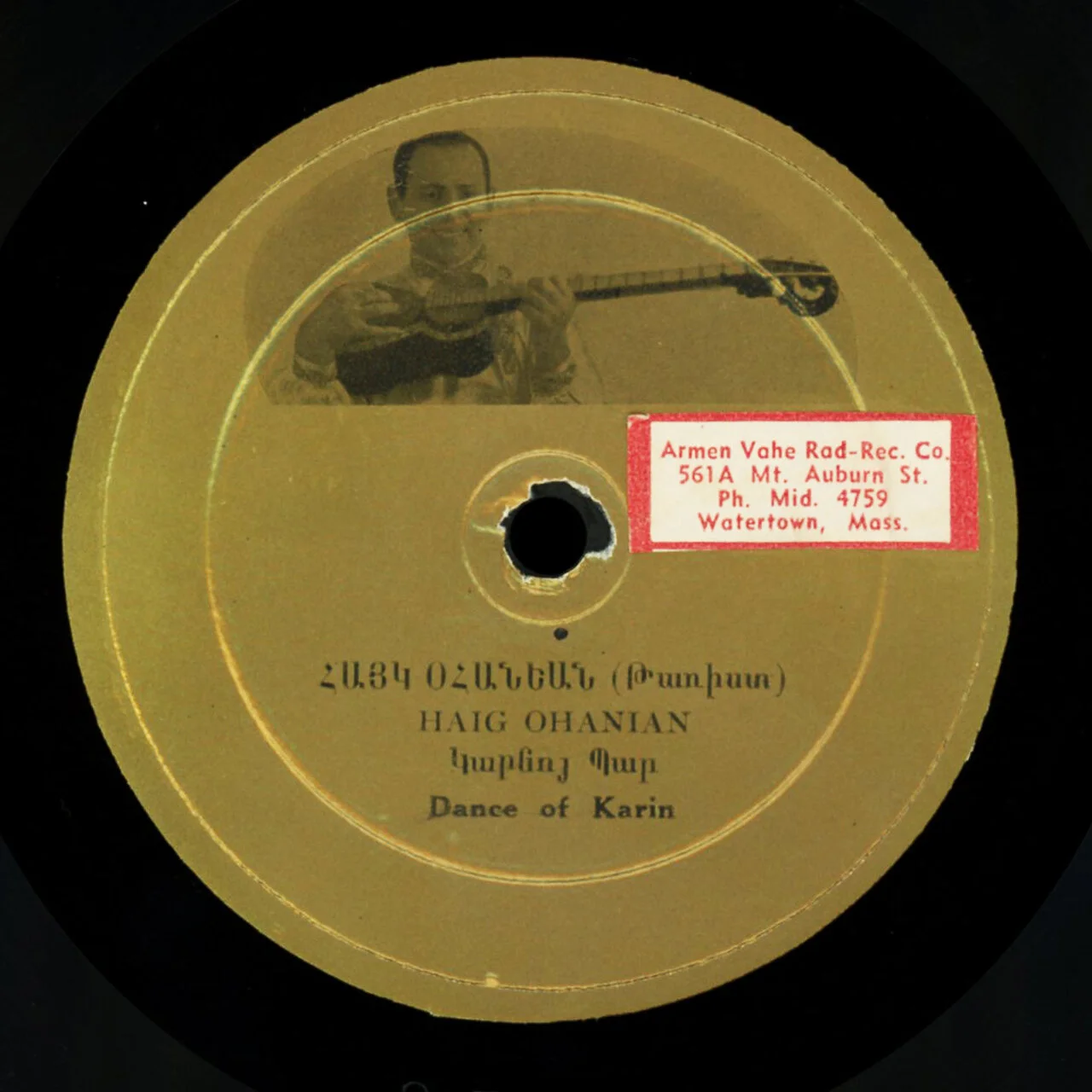
The tar and the work of Haig Ohanian and George Shah-Baronian
The tar, a long-neck lute, has been a central instrument of Armenian folk music for centuries. The instrument has an hourglass-shaped body carved out of mulberry and covered with a vellum made of cow heart. It usually has between six and eleven strings, and twenty-five to twenty-eight adjustable frets (which determine the notes and scales playable on the instrument).
In the Sound Archive of the Museum are several recordings by two Armenian tar players and entrepreneurs, who recorded and performed extensively on this instrument in the United States. They are George Shah-Baronian and Haig Ohanian. Both operated their own private record labels to publish their works, and both presented the traditional and historical repertoire of the instrument while also modernizing its use in the context of American popular music.