
Sound Archive
The following are selections from the museum's roughly 3,000 disc collection of early Armenian recordings and musical ephemera. Explore the links below to listen to songs, learn about pivotal musicians and see images of original records.
A special thanks to Jesse Kenas Collins, Harry Kezelian, and Harout Arakelian whose ongoing contributions of research and consultation have been critical to assembling the writings presented here.
A special thanks to the SJS Charitable Trust for their generous support of our work to digitize and share our collection of 78 rpm records.

Nevarthe Jivelekian, Grikor Suni and the Victory Record Company of Malden, MA
A stunning and integral part of the Armenian musical tradition in the 20th century is that of Armenian classical singers. Their work extends largely out of the choral tradition of the Armenian Church and highlights a variety of musicologists and composers.
Sopranos, often accompanied by piano or violin, codified and preserved a repertoire of Armenian Church hymns and folk songs as well as works by some of the foremost modern Armenian composers. Several women in this tradition recorded and performed prolifically in the United States, beginning in April 1917 with Zabelle Panosian, whose recording of Groung for Columbia Records was exceptionally popular.
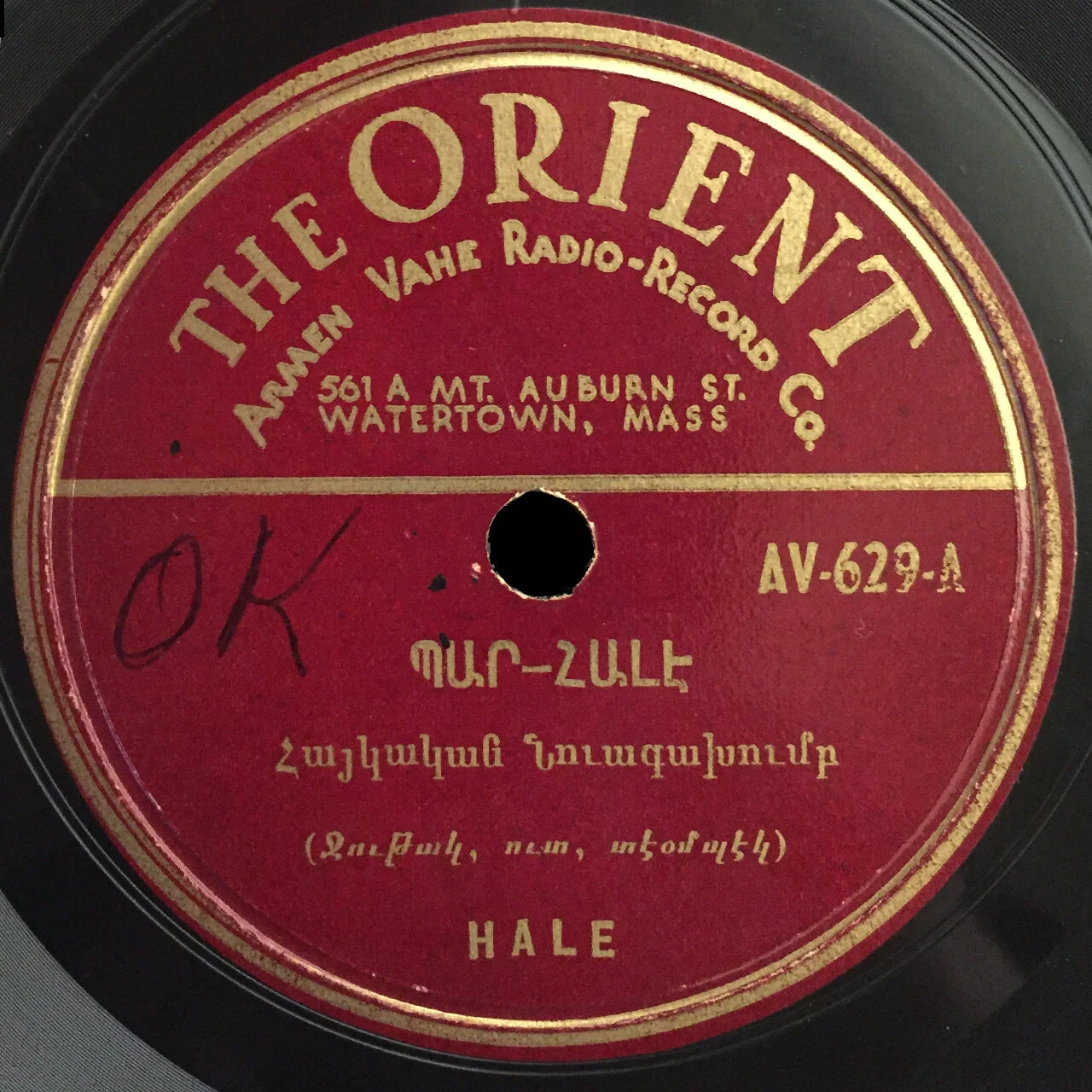
Armen Vahe Radio-Record Co
In his store, Armen sold appliances, radios, record players, and, of course, records. The business had a longstanding relationship with the company RCA for whom they provided services such as tube testing for the devices they retailed. RCA also advertised many promotional activities and services at the time, including an ad campaign in 1932 offering customers a chance to make a recording of their own.⁴ Their contract with RCA provided extensive advertising and by 1934 they had won awards from the company as a notable dealer in New England.⁵ The extent of their record sales in the Armenian community throughout New England is attested to by the large portion of discs in the Armenian Museum collection that bear dealer stickers from the store. Through his relationship with RCA, Armen also operated his own record label called “The Orient”. The Museum’s collection holds 30 different releases on the label, though it is likely that this is only a portion of the recordings they published. Many of the records pressed by the label were reissues of popular music made for RCA, and though these records sold well, they were not the recordings behind which Armen put his more personal and community-minded energy.
The Incomplete Story of Mardiros Der Sarkis Tashjian & His Brothers
In the year 1909, two unrelated music recording sessions took place in two remarkable locations over five thousand miles apart. One session was held in Gyumri, a city in today’s Republic of Armenia which was then known as Alexandropol. The other was in New York City. From April to September 1909, the Gramophone Company of London sent sound expert Franz Hampe on a recording expedition spanning from the Caucasus to Central Asia¹. Labels such as Gramophone had recorded Armenian music and musicians as early as in 1902, if not earlier, throughout the Caucasus and the Ottoman Empire. The company had already established a regional office in Tbilisi (then Tiflis) and recorded Armenian musicians, such as Bagrat Bagramiants in 1903. On his 1909 journey, Hampe visited Gyumri and proceeded to document the voice of Gomidas Vartabed (Father Gomidas, 1869-1935) the renowned Armenian composer and musicologist. While Gomidas sang on one recording, his student the vocalist Vahan Ter-Arakelian would record numerous compositions by Gomidas for Hampe. While around the same time, some 5, 590 miles westward to Gyumri, in New York City, a twenty-nine year old electrotyper named Mardiros Der Sarkis Tashjian would enter the recording studios of the Columbia Phonograph Company and document the Armenian language for the first time in the United States by recording a total of thirty four songs. Six of the recordings are solo compositions by Mardiros recorded in 1909, while the remaining twenty-eight songs feature he and his brothers Nishan and Levon recorded in 1910. By focusing on the biographical sketches of the Der Sarkis Tashjian brothers, this article explores the first Armenian language commercially released recordings in America.

The Tashjian Brothers
In 1909, Mardiros Der Sarkis Tashjian recorded six songs for the Columbia Phonograph Company. The following year he returned to record again, this time, with his two younger brothers Nishan and Levon recording a total of twenty-eight songs. These recordings not only represent the first recording artists of Armenian descent in the United States, they are also the first in the Armenian language.