
Written by Harout Arakelian
In front of the microphone, Armand Tokatyan stood as a bright star. He was a celebrated voice whose prolific career spanned four decades, consisting of at least 38 leading roles, 335 opera performances, and more than 120 concerts. Having spent decades on stage traveling through Asia, Europe, and South, Central, and North America, Tokatyan went into semi-retirement in 1948 when he settled down in Pasadena, California, and became a vocal teacher and was involved in the local Armenian community. He recorded a set of four 78rpm records, consisting of eight songs, titled “Gems of Armenian Songs.” Of the album Tokatyan stated, “Only now have I had the opportunity to fulfill a life-long ambition. This album of Armenian songs represents much of what I hold most dear and all I have so far done in the Armenian repertory on records.”
Tokatyan utilized his star power to bring awareness to and promote the work of ANCHA (American National Committee to Aid Homeless Armenians, est. 1947), beginning in 1948 with a benefit concert at the Opera House in San Francisco. Tokatyan continued to perform in California with concerts in San Francisco, Fresno, and throughout Los Angeles. Tokatyan became ingrained in the Los Angeles Armenian arts and theater scene, working with names familiar to our Sound Archive readers (Zaruhi Elmassian, Marshall Chashoudian, George Shah-Baronian, Ara Sevanian, Yeranouhi Mooshian, and numerous other artists and musicians).
For a biographical sketch of Armand Tokatyan, we are providing an abridged version of the liner notes from his album set titled “A Vignette,” written by Aram Tolegian, a prominent Armenian-American intellectual, literary scholar, and educator:
“Born in Bulgaria in 1898, already when scarcely fourteen years old we find Tokatyan singing in the Catholic Church Choir of Alexandria, Egypt; and in the same year, while attending the Alexandria Conservatory of Music, we see him as a member of Gomidas Vartabed’s Choir, making appearances in that city and Cairo. A year later (1913) our subject is in Paris singing in the cafes of the Montmartre, while just before World War I, having joined a Greek musical comedy company, he made appearances in Athens, Mitylene and Patras. At the outbreak of war Tokatyan is again back in Alexandria, this time appearing in the performances of the local Italian Musical Comedy Group. During the war years, between 1914-1918, he was commissioned to entertain Allied soldiers in Cairo.
In 1921 a scout of the famous impresario of the Metropolitan Opera Company, Gatti Casazza, heard Tokatyan and arranged for an audition in Milan. Encouraged by him to leave for America, Tokatyan arrived in the United States in 1921, going directly to Los Angeles where he sang at Grauman’s Million Dollar Theatre. In 1922, Tokatyan was engaged by Antonio Scotti for the Scotti Opera Company Spring Tour, making his first opera debut in America with Alice Gentle in Birmingham, Alabama. Success now followed success. When the curtains went down on the first act of “La Tosca,” there awaited Tokatyan a telegram from Casazza inviting him to join the “Met” for four years. The season of 1922-1923 saw Tokatyan making his debut at the Metropolitan, scoring instant success as Turiddu in “Cavalleria Rusticana.” His successes were now at floodtide. From 1924-1929 Tokatyan toured the United States with the Metropolitan Opera Company, making appearances in many roles in all of the major operatic festivals.
Now an established world-renowned tenor, Tokatyan [quit] the Metropolitan, and from 1931-1934 shuttled back and forth from America to European capitals, scoring one success after another.
Following this European tour, Tokatyan re-joined the Metropolitan Opera Company Spring Season, 1934-1935, offering once again, in 1935, all his energies to the regular seasons of that Company, but appearing in Central and South American capitals during the Spring seasons, particularly at the Teatro de Bellas Artes in Mexico City whose enthusiastic and responsive audiences embraced Tokatyan as their very own. In Mexico City, too, he made his first full-length motion picture, “Mujer contra Mujer,” [in] 1946, and also appeared regularly on Radio Station XEW in that city, having his own radio hour.
Returning to Los Angeles in 1948, the city to which he had first come in 1921, Tokatyan appeared in his Silver Jubilee Concert at the Wilshire Ebell Theatre, sharing his manifold virtuosities with an intimate audience of many years’ standing.”
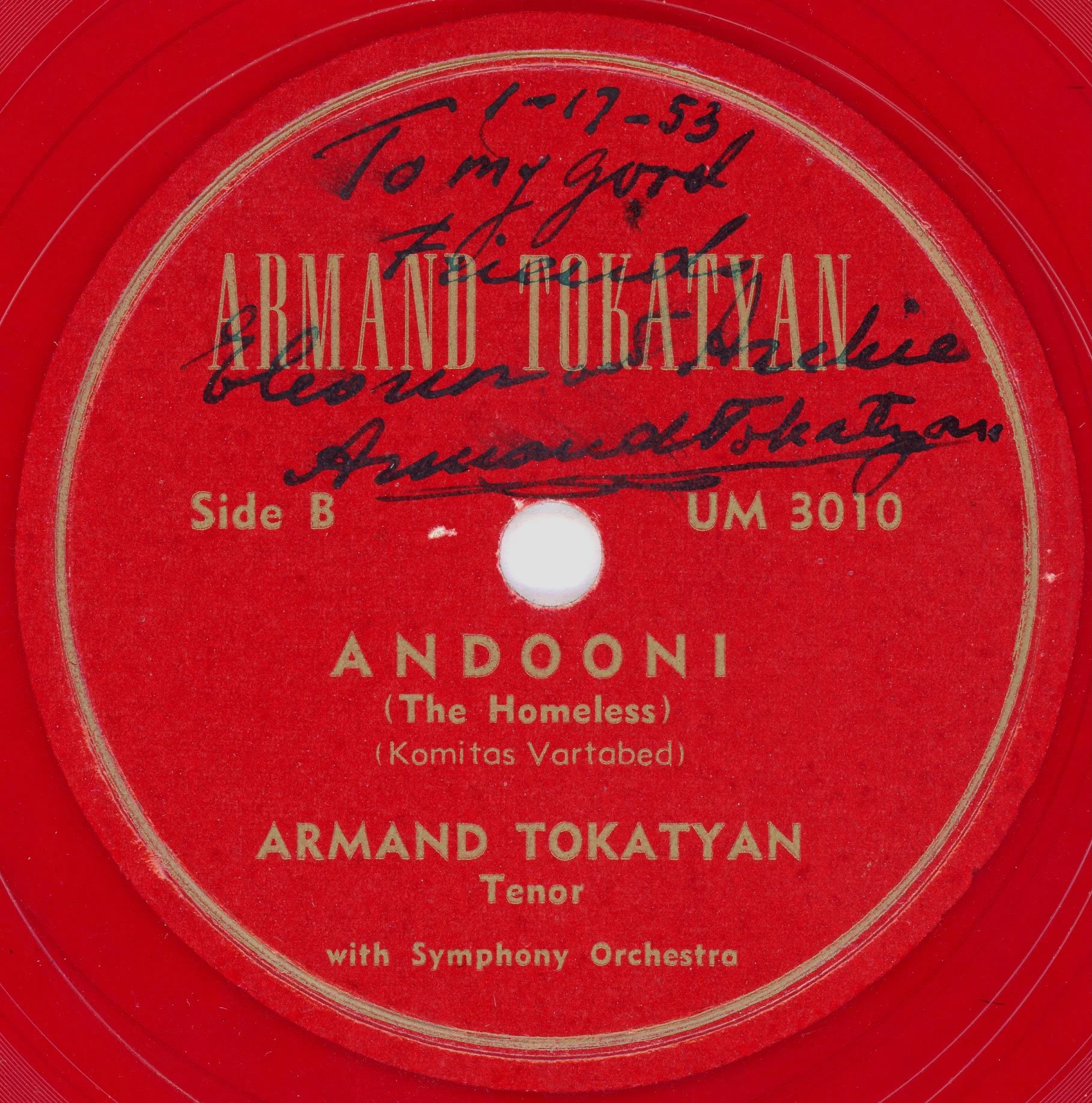
Tokatyan’s recording discography was not limited to the eight songs found on the “Gems of Armenian Music” album set; he recorded numerous sessions for labels such as RCA Victor, Vocalion, and Hispania Records, and has been featured on many LP and CD reissues. While his first Armenian recordings were produced in 1930 for Victor Records, this article features four recordings of Tokatyan from his album set recorded in Los Angeles in the late 1940s. Of the four songs, two are composed by Romanos Melikian, Varte and Varyi Dzaghig. Also included are Bejingo, composed by Vagharshak Srvantzdiants, and Komitas Vartabed’s Andooni.
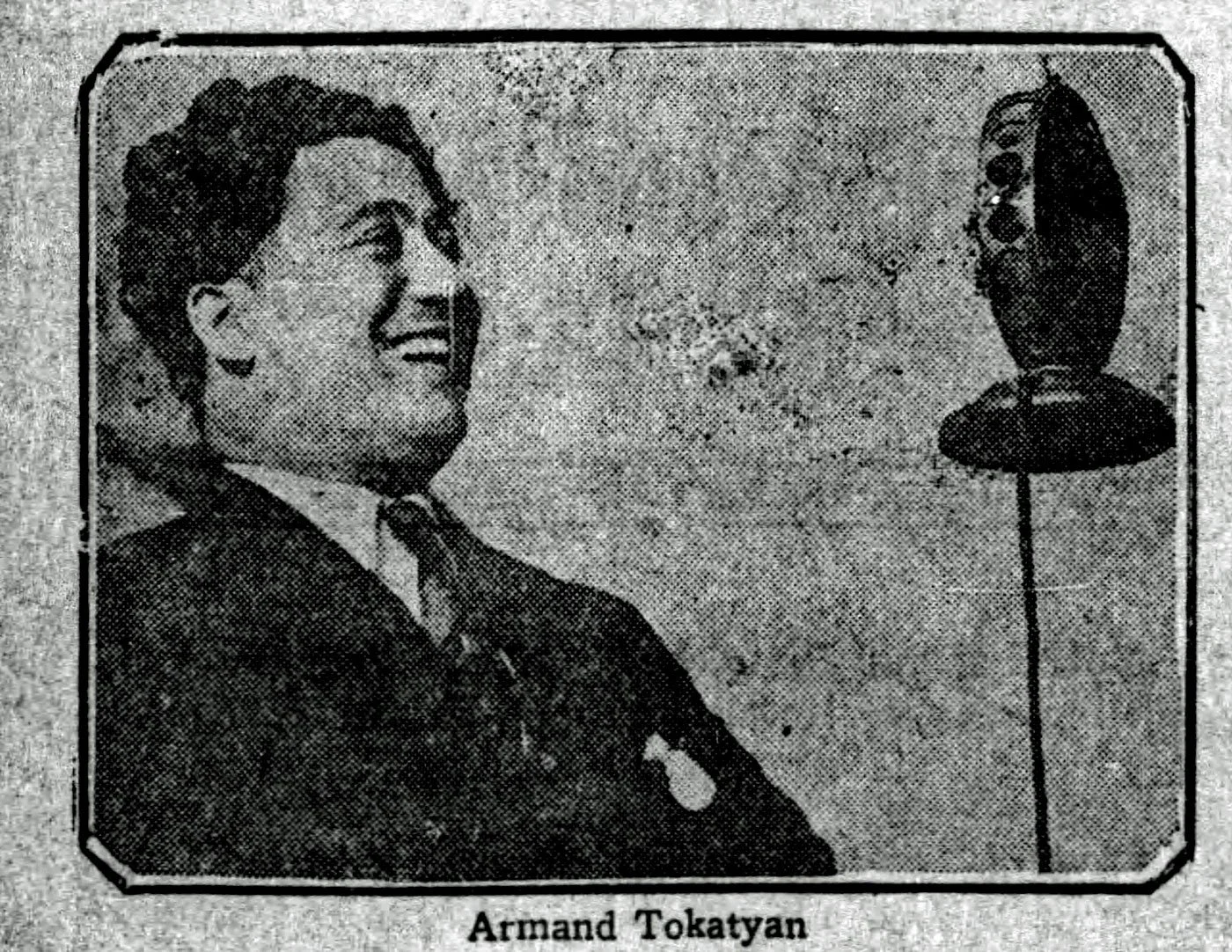
Portrait of Armand Tokatyan published in the Sept 16, 1923 edition of the Los Angeles Times,(Image source: Newspapers.com)
A special thanks to the SJS Charitable Trust for their generous support of our work to digitize and share our collection of 78 rpm records.