
Sound Archive
The following are selections from the museum's roughly 3,000 disc collection of early Armenian recordings and musical ephemera. Explore the links below to listen to songs, learn about pivotal musicians and see images of original records.
A special thanks to Jesse Kenas Collins, Harry Kezelian, and Harout Arakelian whose ongoing contributions of research and consultation have been critical to assembling the writings presented here.
A special thanks to the SJS Charitable Trust for their generous support of our work to digitize and share our collection of 78 rpm records.

Gomidas: Music and Memory
On April 2, 2025, Governor Maura Healey declared April as Armenian American Heritage Month in Massachusetts. To honor this, the Sound Archive is spotlighting Gomidas Vartabed through a special song selection and a rare archival discovery that raises the question: what might have changed in his life and Armenian music if a missed opportunity had been realized?
Armenians began settling in the U.S. in small numbers by the mid-19th century, with Worcester, Massachusetts, becoming the first organized community. In 1891, Worcester's Armenians founded the first Armenian Apostolic church in America. Some, like Moses Gulesian—a key figure in preserving the USS Constitution—later moved to Boston. Gulesian also worked on the 1901 renovation of Boston’s Old State House, where a time capsule was placed in a copper lion. When opened in the 2010s, it revealed a U.S. diplomatic report from 1897 documenting the Ottoman Empire’s massacres of Armenians, a striking historical connection uncovered by architect Don Tellalian.

Anoush Karoun: A History of a Beloved Song
The art song Անուշ Գարուն (EA: Anush Garun; WA: Anoush Karoun) was composed by Daniel Ghazarian (1883–1958) in Soviet Armenia, likely in the late 1920s. Ghazarian, initially a shoemaker, was encouraged by his teacher and fellow composer Grikor Suni to pursue music. He moved to Baku in 1907, then Tbilisi, where he graduated from the Tbilisi Music College in 1911. After surviving WWI and the Russian Revolution, he graduated from the Tbilisi Conservatory in 1921. Ghazarian became a key figure in modern classical music education in Armenia and the Caucasus.

The Songs of Pepo
Our primary focus has been on commercially-released recordings, lacquer/home recordings, and re-issued records. While we’ve discussed Armenian films previously, with this article we shift our attention to an experimental recording: not quite a soundtrack but a medley of film music from the 1935 movie Pepo, the first Armenian language sound film produced in Soviet Armenia.
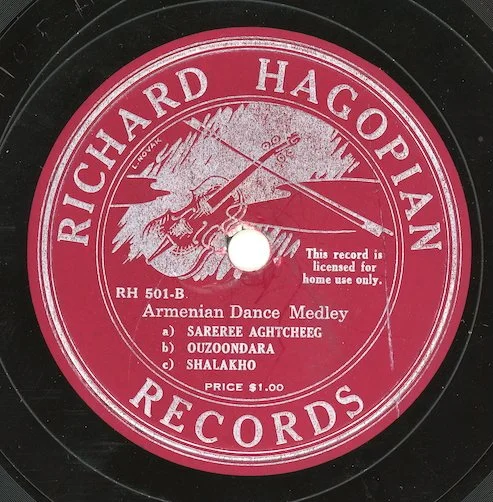
Richard G. Hagopian: An Educator Through Music
When most people hear the name Richard Hagopian, they might think of the master oud player and singer who has made an immeasurable impact on the modern history of Armenian music in America. While his work and impact deserves the fullest exploration, here we take a look at a lesser known musician by the same name.
Richard G. Hagopian carved a unique path with his musical and educational career, stradling the worlds of the concert hall, Armenian music, and music education. Within this career he left us with only one commercially produced 78rpm record from 1949, but within the Museum’s collection, two unreleased lacquer records from 1951 have recently surfaced, bringing his known recorded output to a total of six songs.

Sound Archive 2024: Year in Review
As we close out the fourth year of the Sound Archive project here at the Armenian Museum of America, we are thrilled to have compiled 40 presentations in that time. Each has been dedicated to a different story of Armenian artists who made an impact on the musical and cultural heritage through the legacy of their audio recordings. Across those 40 articles, we have shared 156 different recordings, all digitized and restored from the Museum's expansive collection of early to mid-20th century 78rpm records. Presented here are some highlights from this year's selections.

Megerditch Douzjian: An Everlasting Star
Megerditch Douzjian, born in Dikranagerd in 1896, arrived in the U.S. in 1921 after surviving the Genocide and World War I in hiding. He settled in New Jersey, where he became involved in the Hunchakian party and the Paramaz Dramatic Association. His success on stage led to a recording career, beginning in 1925, where he recorded numerous songs for various labels and he continued performing with the Paramaz troupe until his last performance in 1947.

Kurken M. Alemshah: From Bardizag to Paris
This installment of the Sound Archive highlights recordings made in late 1947 by Armenian composer and conductor Kurken Alemshah in Paris, shortly before his untimely death. A significant figure in modern Armenian music, Alemshah merged traditional Eastern Armenian melodies with Western classical techniques, drawing inspiration from composers like Sayat Nova and Gomidas Vartabed. The recordings feature the soprano Asdghig Arakelian and showcase Alemshah's talents, which had flourished throughout his career as a teacher and composer between Paris and Venice. Despite passing away just before a performance in Detroit, Alemshah left a lasting legacy, influencing Armenian classical music, with his works being featured posthumously by the Armenian National Chorus shortly after his death.

Zaruhi Elmassian & Setrag Vartian: On Stage & Screen
Setrag Vartian and Zaruhi Elmassian amazed and impressed audiences from stage to screen. Before meeting, they had each gained national recognition: Zaruhi as a singer and Setrag as an entertainer. Eventually eloping to Las Vegas in 1942, the couple became invaluable to the Armenian community through continued commitment to Armenian art and culture.

Dr. Elizabeth Gregory: Preserving the Folk Songs of Van
Western Armenian folk music was not only preserved through social gatherings or widely distributed recordings, but also through the private sphere. As a practice often carried on by women and existing outside the market of commercial recording, it was not until consumer level home recording equipment became widely available in the 1940s that much of this repertoire was recorded. We are fortunate to be able to share the privately recorded rendition of the Van folk song Le Le Jinar, sung by the late Dr. Elizabeth Gregory, a woman whose professional career in medicine and support of the arts were as impactful as her voice. The recording was made in the mid 1940s to 1950s on a one-of-a-kind home recorded lacquer disc, likely as part of an exchange between Elizabeth and the artist Yenovk Der Hagopian.