
Sound Archive
The following are selections from the museum's roughly 3,000 disc collection of early Armenian recordings and musical ephemera. Explore the links below to listen to songs, learn about pivotal musicians and see images of original records.
A special thanks to Jesse Kenas Collins, Harry Kezelian, and Harout Arakelian whose ongoing contributions of research and consultation have been critical to assembling the writings presented here.
A special thanks to the SJS Charitable Trust for their generous support of our work to digitize and share our collection of 78 rpm records.

Souren Baronian: A Jazzman with an Armenian Swing
In post-World War II America, a generation of American born Armenians began recording music. In 1949, the Vosbikians and the Nor-Ikes would redefine Armenian music and create a cultural phenomenon. Other bands followed including the Gomidas Band, Aramite Band, the Orientals, the Ararat Band, and the Barsamian Orchestra. This profile of Souren Baronian is the beginning of a series of posts related to the young Armenian-American musicians.
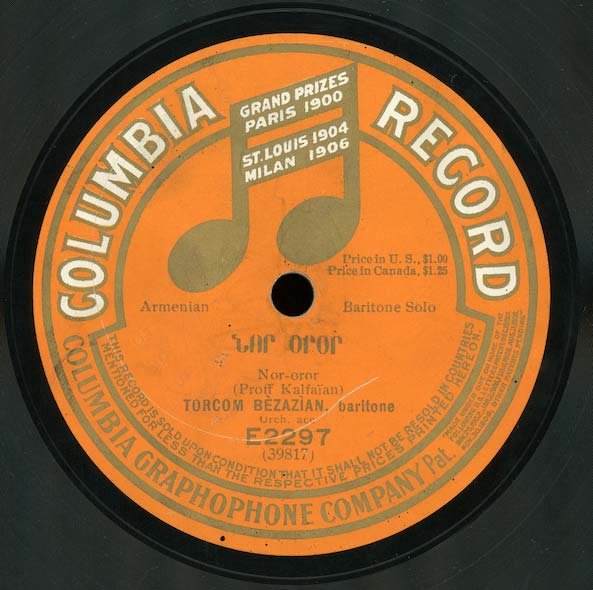
Torcom Bezazian: The Prolific Baritone
With a short yet colorful career in the United States of America, Torcom Bézazian can be considered the most prolific Armenian recording artist of the early 78 rpm era and the only Armenian to record with the three major labels of the era, Columbia, Victor and Edison. Born in Constantinople on September 23, 1889, Bezazian fled the Ottoman Empire and pursued an education in France where he graduated with a degree in engineering from the University of Nancy. Bezazian forsook his career in engineering, and began a serious study of music. Like Armenag Shah-Mouradian and Krikor Proff-Kalfaian, Bezazian studied with Vincent D’Indy. Torcom arrived in the United States in 1913 and over the next decade and a half the baritone enjoyed a successful career on the opera and vaudeville stages.

Mesrob Takakjian: An East West Passage
The three songs presented today all feature the master clarinetist Mesrob Takakjian. The first, titled Yes Sirer Em (I Have Loved), is a clarinet solo and a clear display of Takakjian’s skill. Also included are Gigo, a song including a strong introductory clarinet solo and March of Antranig, a well known patriotic ballad which is interpreted by Takakjian in a 10/8 rhythmic style.
Born in Palu, clarinetist Mesrob Takakjian arrived in the United States in 1912 as a teenager; he would resettle in Fresno, California in the early 1920s. While living in Providence, Rhode Island, Takakjian began his music career. His name is first seen on a record in 1924/5 on the Margosian Records label, though it is presumed he was recorded earlier in the late 1910s. His promising music career in the New York area was cut short when he contracted tuberculosis after he allowed a fellow musician to use one of his reeds, thus leading to his migration to California for healthier weather. He would appear on two discs recorded for Columbia Records in Los Angeles in 1929, accompanying Oscar Kevorkian.

Zabelle Panosian: Another Take
Today's post features the stunning voice of Zabelle Panosian, an Armenian soprano and recording star of the early 20th century. Once a household name for Armenians in the 1910s and 1920s, the recent publication of Zabelle Panosian: I am Servant of Your Voice, a book and CD compilation by Canary Records, has taken great effort to bring Zabelle back into focus and let her voice be heard and celebrated again in the 21st century.

Masha Sourabian - Pioneer of the Armenian Stage
Masha (Marie) Sourabian had an illustrious career on the Armenian stage as an actor and vocalist. She was born in the town of Yekaterinodar, modern day Krasnodar, Russia on February 16, 1896. Her musical training began at the Moscow Conservatory of Music. Masha met and married Armenian actor Setrak Sourabian in 1919, in Tiflis. Together they formed the Hay Dramatic Operet Khoump (Armenian Dramatic Operetta Troupe) and began touring with stops in various Armenian communities with performances in Tiflis, Yerevan, Baku, Smyrna, and Constantinople.

Like Father, Like Son: The Joyful Music of Stepan and Haigaz Simonian
Among the numerous musicians from the Kharpert region that recorded for Columbia Records in the 1920s, the father and son duo Stepan and Haigaz Simonian stand out for their exuberant renditions of regional dances. Stepan Simonian was born in 1887 in Mezire and came to the United States in 1907, settling first in Haverhill, then later in Worcester, MA, where he worked as a cobbler. He and his wife Sophia Berberian, a Kharpert Assyrian, had two sons and two daughters. Their oldest son and Stepan’s collaborator, Haigaz, was born in 1909 in Worcester.

Nevart Dzeron-Koshkarian: Portrait of an Artist
Nevart Dzeron-Koshkarian, sometimes known as Nouart, was a fine artist and art educator. She was born in Perchanj, a village that was south of Kharpert. She would arrive in the United States in 1893. Daughter to engineer and author Manoog A. Dzeron, who wrote, “Nevart having received her preparatory education in Worcester and Chicago, completed a 7- year course at the Chicago Art Institute and graduated with honors as an artist. For an additional year she went to France and Italy to refine her art. She married Prof. Bedros Goshgarian. They settled in New Jersey. Nevart has always remained a patriotic Armenian. During the Near East Relief fundraising she traveled to important centers in America, lecturing on indigenous Armenian music and singing Armenian songs.
Sound Archive 2021 - Year in Review
As we enter the New Year we’re taking a look back at the artists and topics covered in the Sound Archive posts since they began in March of 2021. We hope you enjoy the selections here which bring together on one page some of the music we’ve shared to date.

Vartan Margosian, the Nightingale of Kharpert
Vartan Margosian’s style of music was unique and will probably never again be repeated. He was not a highly trained musician, and he wasn’t even a “master player” in the folk tradition. There were probably any number of Armenians like him, who knew how to play an instrument and who knew the folk songs of their local area. That doesn’t mean he wasn’t great, but one asks oneself how many Vartans we lost due to the Armenian Genocide. Vartan’s special quality lies in two things, as far as this listener is concerned: his near-heroic attempt to document the songs of his native land by printing an incredible amount of records on his own dime, and his irrepressible spirit which shines through in all his recordings and in the surviving photographs, a man who must have been a naturally happy person, subjected to loss and destruction of his homeland and most likely, his parents and extended family. Vartan’s singing verges from deeply, emotionally melancholic to sprightly, happy, and contented, reflecting his and his people’s loss on the one hand and his successful realization of the American Dream and happy family life on the other. The songs included here are mostly from his early recordings and mostly from the second half of 1923 and the first half 1924.