
Family Recipe Box: Armenian Genocide Remembrance Day
By Sally Cragin
Lowell Sun
April 22, 2026
Thank you to all the kind readers who’ve been in touch recently. I’ve had lovely conversations about many of the collations I’ve featured in this column since beginning in August, 2024. As we turn the corner on our 18-month birthday, I wanted to salute the idea of “feast for the eyes” as much as the feast on the table.
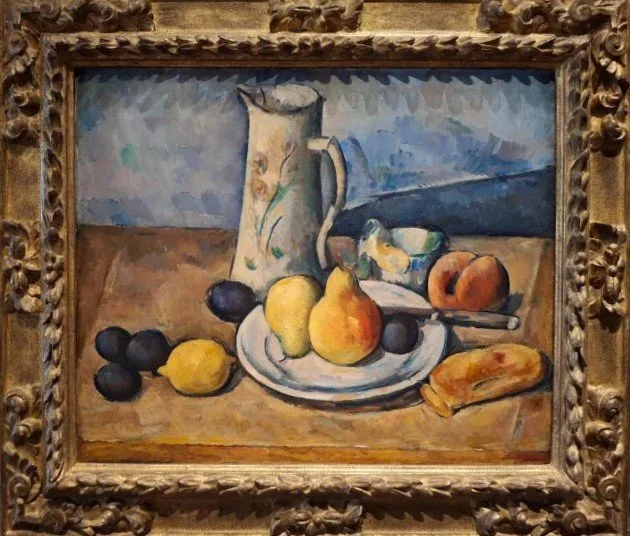
This painting is from “Arshile Gorky: Redrawing Community and Connections,” at the Armenian Museum of America in Watertown (photo by Sally Cragin)
Recently, my friend Susan Navarre and I drove to Watertown, one of the first American cities to host the diasporic Armenians. Though there are far fewer Armenians there than in Glendale, California, (8,000 vs. 60,000), the Armenian Museum of America is an impressive treasure house of Armenian culture ranging from artifacts that are thousands of years old to a recent exhibition of abstract paintings by musician Serj Tankian (of the rock band System of a Down).
No, the “feast for the eyes” that drew us east was “Arshile Gorky: Redrawing Community and Connections,” a never-before-assembled collection of Gorky’s paintings, drawings and prints.
Gorky (1904-1948), born Vostanik Manoug Adoian in Khorgom, Vilayet of Van, in the Ottoman Empire, now Eastern Turkey. His father left the family to settle in the states in 1908, and the remaining family escaped into territory controlled by Russia. Eventually the family arrived in Yerevan, where his mother died of starvation. Gorky arrived in the states in 1920, when he was 16. He was reconnected with his father, but they soon separated.
Adoian took the name “Arshile Gorky,” and told people he came from the Georgian nobility. He first settled in Watertown, where he worked for a rubber company (and was fired for drawing on the crates). While in New England, he studied at the New England School of Art. His early paintings reflect an interest in Impressionism, and he also became an instructor.
By 1923, he was living in New York City, where the work of Paul Cezanne can be seen in some of those paintings. He got a teaching position at the Grand Central School of Art, and made friends with other emerging artists such as Willem De Kooning. Over time, his work became more abstract and utterly unique.
“Forging relationships while he transformed himself into an artist in the mid-1920s was a personal and professional endeavor. For Gorky, there was little separation between the two – fellow artists became friends and he loved his friends like family,” writes Curator Kim S. Theriault. “This makes sense for someone whose homeland was taken from him and whose trauma was unacknowledged. Like most Armenians, Gorky did not speak of his ordeal and suffering before coming to America, and the Armenian Genocide had yet to be internationally recognized.”
“We aimed high in the planning of this show dedicated to an Armenian artist who immigrated to Watertown in the aftermath of the Genocide, like so many of our compatriots,” explains Executive Director Jason Sohigian. The exhibition was selected by Jared Bowen for a “Pick of the Week” on WBGH’s “The Culture Show.”
An additional bonus is that visitors can swing down Mt. Auburn Street and visit the Armenian and Near Eastern grocery stores to purchase Armenian food and ingredients. You can bet we’ll be back.