
Diana Markosian’s ‘Father,’ at the Armenian Museum of America, makes the personal universal
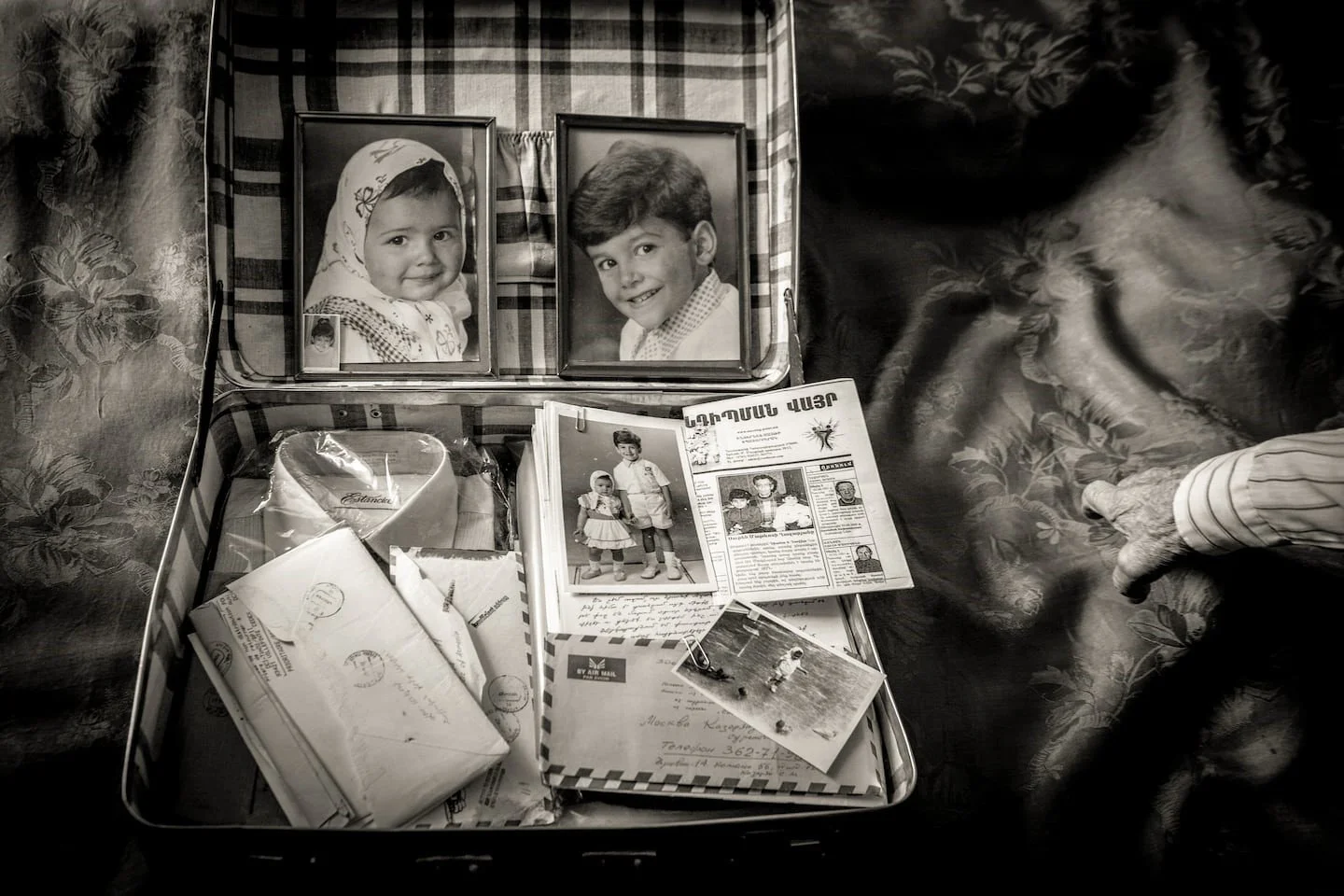
Diana Markosian, My Grandfather's Suitcase, 2014-2024, archival pigment print, 65 x 45 inches, on view at the Armenian Museum of America
By Mark Feeney, Boston Globe
WATERTOWN — Diana Markosian’s “Father” works on at least three levels: individual, national or ethnic, and universal. Moving and deeply personal, the show runs at the Armenian Museum of America through Sept. 13. The museum’s Anahit Gasparyan curated.
Markosian was born in Moscow in 1989. Her parents had already separated before her birth. Her mother abruptly relocated to California with Markosian and her brother seven years later. How abruptly? She left no word with her husband, Markosian’s father. Doing her best to remove any memory of him from their children’s lives, she even sliced his image out of family photos.
Fifteen years later, Markosian began searching for him. That she eventually found him is attested to by a video, running nearly seven minutes, and the very handsome photographs in the show. There are more than a dozen, most are black and white, some as large as 5 feet by 4 feet.
After his wife and children had left, Markosian returned to Armenia from Moscow. “Father” is a study in the geography of emotion and memory: Armenia, Russia, California. Few peoples have experienced displacement as Armenians have. In that regard, “Father” being exhibited at an Armenian museum is doubly fitting. There’s Markosian being Armenian, of course. More than that, the exhibition can be seen as part of a much larger mosaic of the Armenian experience of separation and exile.
The show’s universality is indirect. Yes, it concerns a grown child’s relationship with her father. That’s so common as to approach the universal, if not compellingly so. But what matters to her is that the relationship was grounded in enforced separation.
Thankfully, the separation of parent and child isn’t universal (even when used by certain governments as a tool of state coercion). Surely, though, every parent has considered the possibility of his or her child being suddenly, unexpectedly gone. In that sense, despite the specificity of Markosian’s experience, it speaks to a much larger truth — or fear — likely to chime with viewers who are neither Armenian nor have suffered a version of what she and her father underwent.
The extent of his own suffering is apparent in the 55 letters and documents from him that Markosian has included in the show, all seeking to find the whereabouts of his children. Nearby is an Armenian postal box, which takes on a striking emotional weight. The show also includes a selection of family snapshots in their original frames, adding to the sense of domestic intimacy — and familiarity.
Titles matter. That’s obvious. What may be less obvious is that they also define. “Father” is the show’s title, not “Father and Mother” or “Parents” or “Family.” Still, one wonders about Markosian’s mother and feels her absence — if nowhere near the way Markosian felt her father’s actual absence.
Another absence is that of labels for the photographs. Presumably, there aren’t any so as to emphasize evocation rather than mere description or denotation. But is there anything “mere” about description or denotation, let alone when feeling runs so deep?
At Armenian Museum of America, 65 Main St., Watertown, through Sept. 13. 617-926-2562, www.armenianmuseum.org
https://www.bostonglobe.com/2026/07/23/arts/review-diana-markosian-father/